The essential experiences you need to discover in this city of endless perspectives Insider guide by food journalist Dimitris Stathopoulos.
The essential experiences you need to discover in this city of endless perspectives.
Until just a few years ago, before reaching Kalamata, you had to wind down the curves of Tsakona, where each turn revealed a new perspective of the Messenian Plain.
Today, the new national highway drops you directly into a unique world built around the olive tree. It's literally a plunge that suddenly brings you face to face with the distinct character of this Southern Greek region, where nature gives its very best. The car moves quickly, while left and right I notice settlements nestled among the trees, and since it's olive harvest season, you can see crews working in the groves.
I ignore the signs directing me to Kalamata's center and follow this road to its end. There's a reason. It's the sea, and that's what I want to see first upon arriving in Kalamata. This is one of the few large Greek cities with such a beautiful beach: we enjoy it in summer, but even now in winter, this coastline is something unique. Mount Taygetos seems to "oversee" it, giving another dimension to its beauty and filling it with surprises in light and atmosphere as long as you maintain visual contact with it.
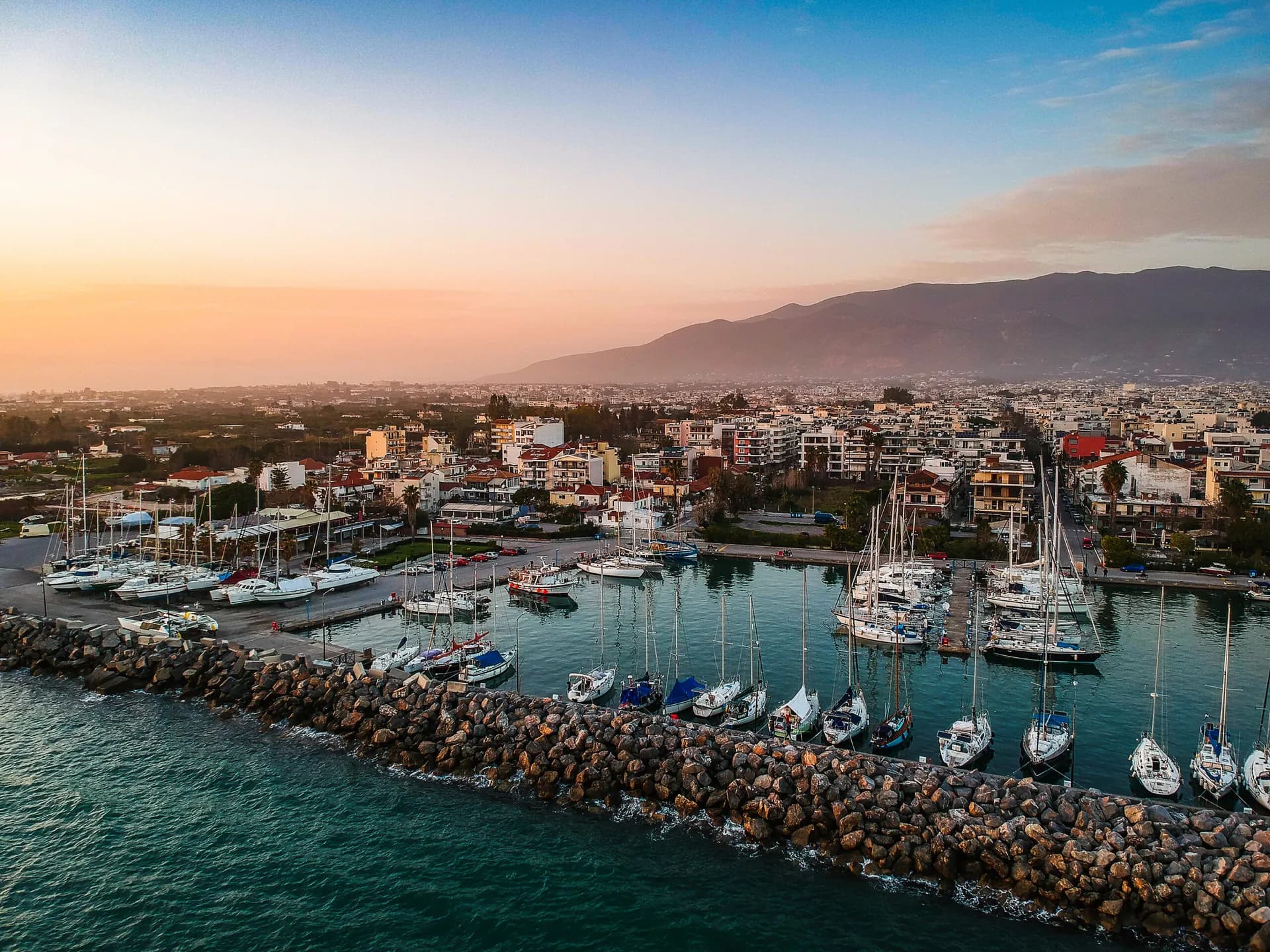
The beach stretches for 2.5 kilometers, and it's particularly interesting to see it now in winter when you can view it from one end to the other. In summer, it fills with people and becomes the meeting point. These are two different perspectives of the same place, yet each has its own positive element that makes it beautiful. We head west and have almost reached the harbor, which was built after intense pressure and demands from merchants of the era who wanted to use it for transporting their goods.
The construction study was assigned in 1872 to French engineer Pascal, who specialized in harbors, while contractor Matsas carried out the construction. Work began in 1882, but it took many years until completion in 1902. Immediately, exports of Messenian products like figs, raisins, and olive oil began to important cities: Smyrna, Constantinople, Marseille, and Trieste. It quickly made the list of the country's five most important harbors, and later, ocean liners departed from here carrying people emigrating to America. Subsequently, with the parallel industrialization of the city, a reverse trend in the harbor's commercial activity was observed, as expected. Today, just past the harbor, an excellent marina has been built that hosts dozens of boats, providing yet another way for people to visit the city.
We leave the waterfront behind and make a brief stop at the Railway Park, which extends alongside the city's main street, Aristomenous. This is an area of over 50 acres very close to the city center with abundant greenery, where you can walk, see the old train station, boarding platforms, steam locomotives, and many other elements related to the railway's operation.
It's worth noting that for more than 10 years now, the Southern Peloponnese railway line has not been operating, nor has the one that crossed the Peloponnese transversely from Corinth through Tripoli to Kalamata.
Leaving the park behind, we walk along Aristomenous Street. This street essentially crosses the largest part of the city, starting from the old town and 23rd March Square and ending at the customs house in the harbor. It's characteristic that when this street was constructed in 1871, its first name was National Coast Road of Kalamata, thus demonstrating both its size and importance. As we climb uphill, the shops become more numerous, as this road coincides with the modern city's commercial center. At the height of King George Square, we see "Freedom," which includes heroes of the Greek Revolution: Papaflessas, Kolokotronis, and Mavromichalis. We then walk along the pedestrianized section of the street and admire beautiful neoclassical buildings, like the one belonging to the Municipality that was the old city hall, and the Rex Hotel building. Aristomenous is a street worth dedicating time to, with a willingness even to deviate into small perpendicular alleys or arcades, as beautiful images are hidden there, atmospheric bars, buildings from other eras struggling to breathe and find their proper place.
Continuing our walk through the city center, we move to the old town, making a mandatory stop at an iconic shop, Tzimi's, for a souvlaki at the emblematic corner of the square. We chat with the communicative Tzimi and of course with his mother, who is over the grill from morning to night. She agrees to be photographed only when I tell her we're friends with her son, and a smile breaks out when I tell her their souvlaki travels around the world. We sit next to the historic Church of the Holy Apostles, where on March 23rd, the fighters of 1821 swore loyalty to the Revolution, a date that gives the square its name. The first section of the church was built at the end of the 11th century, while the second was built during the Venetian period, in the late 17th to early 18th century. If you have time, enter the church, where among other things you can see frescoes from the 16th and 17th centuries.
The large church visible to the right above the 23rd March Square is the cathedral, Ypapanti, and the street connecting the square to the church shares its name. Quite a few shops line both sides, some new, others with decades of history, like Skiadas Pastry Shop with its famous galaktoboureko, and the café-ouzeri O Thiasos, serving mezze since 1917, with traditional gournopoula as their signature dish. A little further up, approaching the church, on our right we'll see Chrysomallis Wine Shop, where you can try wonderful traditional dishes either at the sidewalk tables, inside before the beautiful wine cellar, or in the back courtyard with the large orange tree.
Continuing a bit further we reach the city's beautiful castle. On this hill, the mythological hero Pharis built the Acropolis of Pharai, the ancient name of Kalamata. In the 6th century AD, a Christian church was built upon the ancient ruins. Its reconstruction by a Frankish prince in the 13th century gave it essentially its current form. Passing through various historical phases, in the 19th century it fell into decline, while in 1825, Ibrahim's army caused it great destruction.
It's Saturday and we pass through Kalamata's central market. Fresh fruits and vegetables, honey, olives, olive oil: all the products of Messenia can be found here, while simultaneously supporting the local economy. The space where the market operates is structured precisely for this purpose. You can move easily, shop safely, and why not, exchange a few words with the merchants.
We met Mrs. Vasso. The truth is that her directness, her manner, everything was so beautiful and balanced that you want to approach her and learn about the things on her stand. She was born in Montreal to immigrant parents. When she was 6 years old, they came to Kalamata, but six years later, the great earthquake of Kalamata occurred. The city was largely destroyed and the family left again for Canada. "I wanted to return. I felt that I should live here. And so, I made the decision, left everything there and came to the city. I initially worked in tourism and then for many years at Lambou Pasteli factory." That's more or less her answer to our question about the past, before she continues: "My father-in-law and my husband are involved in honey production. The hives are placed each time in the most suitable locations to have an ideal product."
Alongside this, Vasso decides to make her own things. "I started making ointments, propolis tincture, various other small jars with honey packaging, candles. I'm trying to give another extension to everything the family does. Honey, of course, always remains our main product."
It has a perimeter approaching 9 meters, a height of 14 meters, and was planted in the 4th century AD according to the study results of forester Dr. Pan. Bazigas. This is the Mother Olive Tree, a protected natural monument, belonging to the variety from which the edible Kalamata olives come, the Aetonycholaia Kalamata. It's located within the city's urban fabric in the grounds of the Olive Institute. It's said that from this specific olive tree, thousands of trees of this variety have been produced, as they would graft with its own branches and create new trees.
A cheese synonymous with the region is sfela, which is made in a special way and is classified as a PDO product. It's salty with a rich, acidic flavor, characterized as a semi-hard cheese, and its production according to its PDO classification is permitted only in the prefectures of Messenia and Laconia. We visited the "O Polyfimos" cheese dairy near the village of Eva, where Ilias Petropoulos, the fourth generation of the dairy, showed us the sfela production method, which among other things requires 3 months of aging, is prepared in rectangular pieces, and uses sheep and goat milk. The dairy has been operating since 1939, has won many awards for its dairy products, and among other things produces graviera, dried mizithra, kefalotiri, xerosfel, and yogurt.
The visit to Kalamata won't be complete if we don't take a stroll through Oikonomakou's traditional delicatessen, located on Ithomis Street in the historic center. So we do. It's Saturday just after noon. It's perhaps the best time for a quick mezze, while the Oikonomakou brothers explain details about their products. Beyond the traditional cold cuts sliced in the adjacent space, we see the preparation process of authentic pasto, which is made with pork after first boiling it, then leaving it in salt and then frying it. We try that too, but also many more items like orange sausage, sfela, various pickles, olives. It's not the kind of place where you sit at a table, but right there outside the shop, at two counters, such quick gatherings are set up in no time so that before someone buys, they can have tasted.
Common Questions
What is Messinia known for in terms of food?
Messinia produces some of Greece's finest olive oil, incredible figs, and a style of cooking that is simultaneously rustic and refined. The local kalamata olives you've been eating your whole life come from here — tasting them in their origin region is genuinely different. The tavernas in Koroni and Stoupa are among my favorites in all of Greece.
How do I get to Messinia from Athens?
It's a 3-hour drive south on the E65 — easy and scenic through the Peloponnese. The coastal road near Kalamata is particularly good. I recommend renting a car; public transport gets you there but won't let you explore the villages properly. Day trips from Athens are possible but overnight is much better.