Centuries-old traditions remain beautifully preserved in cities and islands throughout Greece Insider guide by food journalist Dimitris Stathopoulos.
Centuries-old traditions remain beautifully preserved in cities and islands throughout Greece.
More than ever, we need light to triumph over darkness and humanity to make yet another fresh start. With Epiphany, the holiday season concludes, bringing together rich customs and traditions throughout the country. The victory of light arrives as a catalyst, sweeping away every negative disposition and all the evil that may have overtaken the planet, always making room for healthy forces to act and flourish.
Through the traditional blessing of the waters, evil is exorcised and purification comes. At the same time, dozens of ancient customs revive during the final days of the Twelve Days of Christmas, specifically during the two days of Epiphany and the feast of Saint John the Baptist. Through a series of customs that survive to this day, the traditions of centuries remain intact, and the symbolism related to the banishment of evil spirits, human fertility, and the bounty of the earth remains alive.
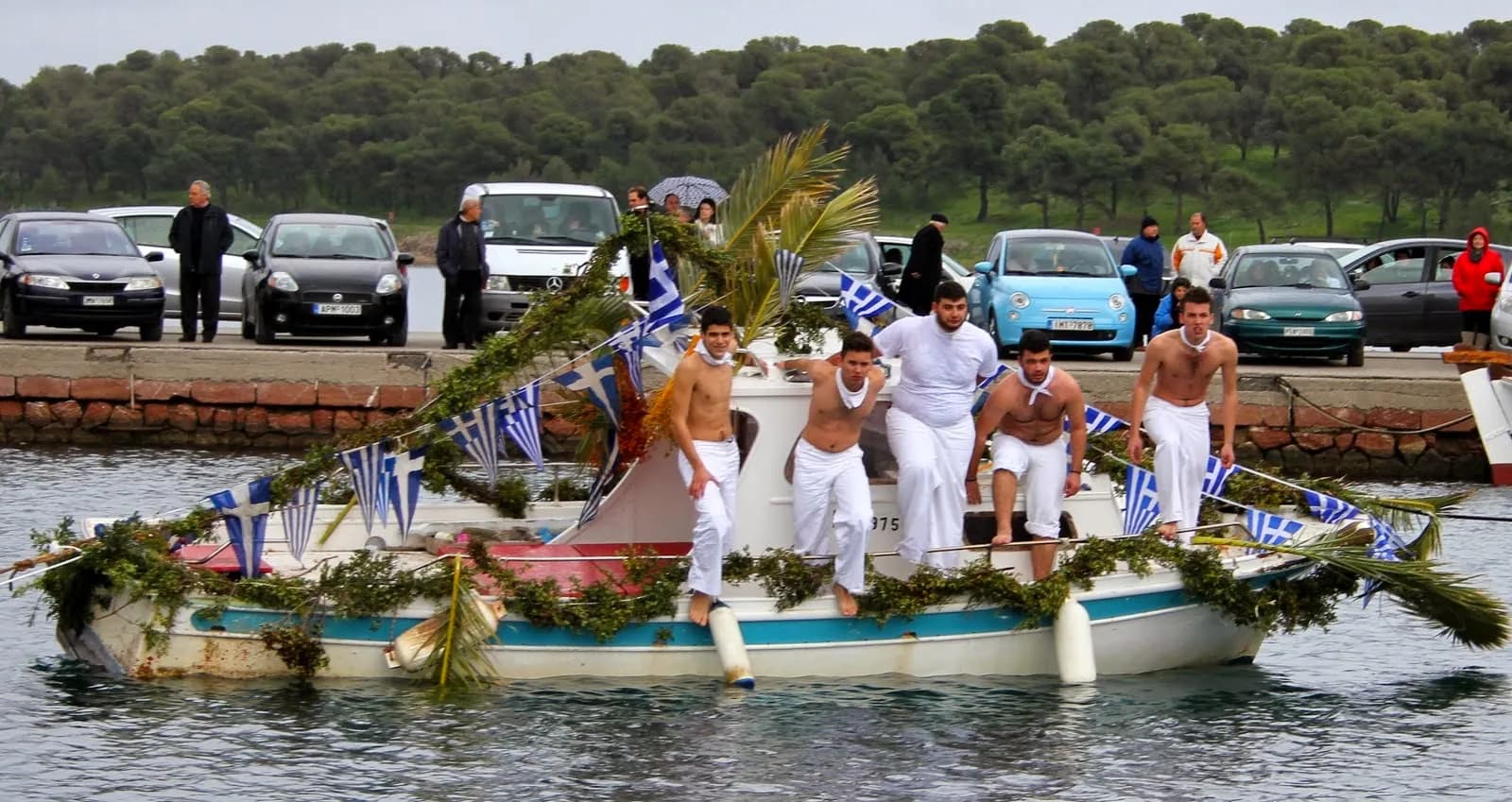
"Giala-Giala" in Ermioni
Young men due to enlist in the military during the year take on the task of decorating boats using palm branches. This happens on the eve of the Lights, when the same evening they pass by homes in Ermioni and receive treats. Afterward, they return to the boats, where they sing and dance the "giala-giala." The next morning, from these boats, they'll be ready to dive to catch the Cross during the blessing of the waters.
The "Arapides" of Drama
On Epiphany day in Nikisiani of Pangaio, Monastiraki, Pagoneri, Pyrgoi, Kali Vrysi, Petrousa, Xiropotamos, and Volaka in Drama, the ritual of the "arapides" takes place with some variations. It's named this way because the participants dress in black capes resembling flokates, as well as sheepskins from goat hides and masks with pointed tops. The shoes worn by those participating in the custom are called "tserouvlia" and are made from raw pig leather. Their woolen pants are called "benevrekia." Around their waists, they wear four shepherd's bells called "tsania," while their faces are covered with the "barmabota" made from goat leather. The barmabota is adorned with a white kerchief decorated with colorful designs, coins, and flowers.
Groups form, and all together make a joint procession through the streets under the deafening sounds of their bells. Two group leaders participate in a ceremonial wrestling match until one's final fall. Around him follows a mystical ceremony that concludes with the resurrection of the dead and the frenzied dance of all. This process symbolizes the death of Dionysus by the Titans and his resurrection by Zeus. It also relates to the "resurrection" of nature after winter's dormancy.
The Camel of Galatista
In Galatista, Halkidiki, the custom of the camel and the abduction revives, which has its roots in the 19th century. The custom involves a man in love who wants to "abduct" his beloved. To distract the Turkish overseer, he sets up a trick. During a celebration, and having prepared a camel effigy, he takes advantage of the commotion and with friends' help hides his beloved inside the camel effigy and escapes with her. Today, the custom revives with the camel effigy walking through the village with six men hiding underneath, dancing and singing.
Diving at Chios
Having great tradition in contact with the sea, on Epiphany day, as in many coastal places in our country, a group of people will dive into the icy waters of the sea to catch the Cross. Here the difference is they'll try to hold their breath and stay in the water as long as possible. At the same time, fishermen will have formed a protective ring around them to protect them from the waves.
River Blessings in Thessaly
In many villages of Thessaly where there are rivers, residents take the icons from the church and transfer them to the river. There, in the icy river waters, they throw the cross and with it sprinkle the icons, which then return to the church, while they customarily sprinkle the blessed water on fields for a good harvest. In several villages in Thessaly, they dip the entire icon into the river.
Oranges in Lefkada
The faithful gather by the sea and the priest throws the cross into the water, as happens in many areas of the country. However, in Lefkada, along with the cross, they throw a bunch of oranges tied together with rope into the sea. Afterward, these blessed oranges are hung next to the icons in churches.
"Ragkoutsaria" in Kastoria
On Epiphany day in Kastoria, the "Ragkoutsaria" revives. Residents wear terrifying masks to exorcise evil from the region and demand payment from passersby for the good they do for the city.
Orange Blossoms in Zakynthos
In Zakynthos, every church is decorated with orange tree branches, orange leaves, oranges, and sword-shaped leaves from kokorakia plants that tradition says grew on the banks of the Jordan River. Also, with bunches of oranges and orange blossoms, the chandeliers and certain icons inside the church are decorated on Epiphany day. Additionally, the faithful place bunches of oranges on the platform set up inside the church where the blessing ceremony will take place, to be baptized by the priests.
Common Questions
Where can I find this in Athens?
The Central Market (Varvakios Agora) on Athinas Street is the best starting point for any serious ingredient hunt in Athens. It's open weekday mornings and is genuinely one of the great food markets of Europe — chaotic, loud, and completely authentic. Go with a local if you can. I take people there on my Athens food walk.
What makes Greek versions of this different from what I've had elsewhere?
Greek cooking is obsessed with quality of ingredients, not complexity of technique. The olive oil is better. The tomatoes taste like tomatoes should. The feta is brined in whey, not plastic brine. When you eat the same dish in Greece vs. a Greek restaurant abroad, you're eating fundamentally different food.