Two women from Thessaloniki reposition Armenonville on the city's gastronomic map By food journalist Dimitris Stathopoulos.
Two women from Thessaloniki reposition Armenonville on the city's gastronomic map.
A dessert, a city, a history. Armenonville. Closely connected to Thessaloniki: the stories hidden behind its origin, and its particular name, are many.
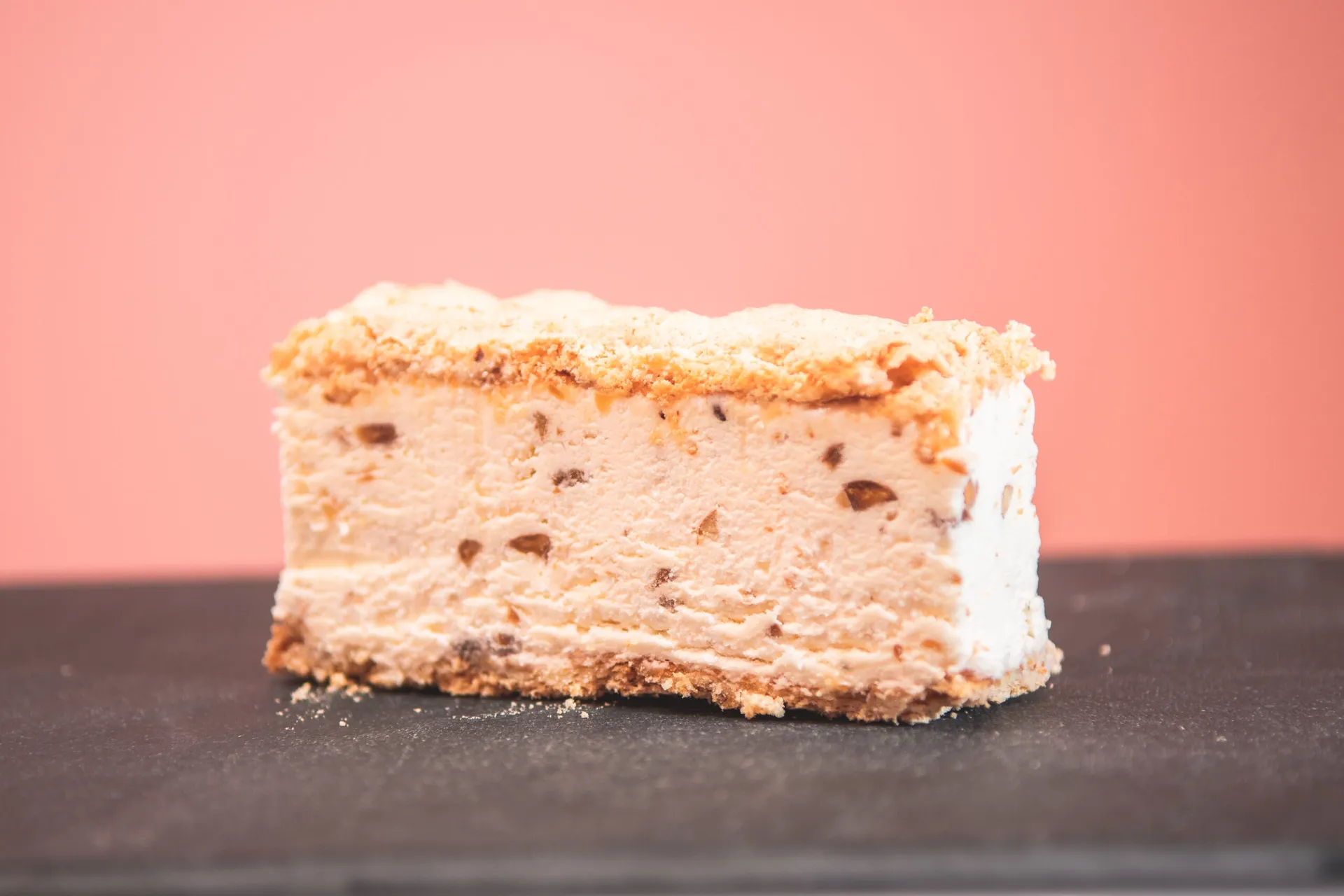
The city's gastronomic legends say it's connected to the presence of French troops there during World War I, hence the Gallic ending. Others refer to a dessert that came from the East, specifically from the Armenians, at the beginning of the century. The essence, of course, lies elsewhere. This dessert established itself in the city and for many decades was a classic treat at all the old pastry shops. It's a preparation that could be described as somewhere between conventional dessert and ice cream. It's velvety and simultaneously soft like a frozen mousse. Inside its mousse, you'll find pieces of meringue that give the whole a chewy texture, as well as caramelized toasted almonds.
Over the years, due to difficulties in its preparation, it was sidelined by fleeting loves until the moment it made an impressive and, more importantly, even tastier comeback. Its dynamic return is inextricably linked to a shop created for this dessert and even borrows its name. It's Armenonville, located in the center of Thessaloniki on Mitropoleos Street, created by two hardworking and inspired childhood friends, Eugenia Kalatzi and Elena Kogimtzi.
"My family maintained pastry shops, both in Thessaloniki and Halkidiki," Eugenia tells travel, who from a young age used to get underfoot of her father in the shop. "I liked the pastry shop. When I was a child, for me it was a dream to manage one day to work there. I saw all those huge kitchen tools for children's eyes and wanted them all. I still remember the first time my father, as a child, assigned me to do something." Since then, of course, things changed dramatically. As she tells us, after reaching adulthood she continued to university where she completed her studies in Agronomy. "Finishing school, it had already become clear to me that I wouldn't deal with plants. Pastry-making was lurking." That's how she entered the family business and began working properly in the pastry shop. "I worked in production and Elena in sales. Five years ago, we decided to both enter production, to learn the craft. Our goal since then was to evolve the recipes, especially that of Armenonville."
On the same wavelength, Elena refers to the challenge of redefining Armenonville and its reentry into our daily lives. "Armenonville was always our favorite dessert, and being difficult and time-consuming to prepare, it was always our goal to showcase it and bring it back to the city and all of Greece. So our goal for the old to remember it and the young to learn it took flesh and bones 3 years ago, and Mitropoleos 102 has become a reference point for the traditional authentic dessert."
Beyond traditional Armenonville, in this small, beautiful shop in the city center, you'll find a variation with chocolate, as well as lemonville with lemon cream, meringue, and the classic base. Another interesting variation is chios mastic, made with Chios mastic mixed into its cream with a layer of kataifi. With orange, with sweet caramel and Himalayan salt, with salted caramel and chocolate sauce, as well as various other variations, complete the experience. Thessaloniki awaits us.
Armenonville / Mitropoleos 102, Thessaloniki
Frequently Asked Questions
What makes Greek food unique?
Greek cuisine is built on simplicity and quality ingredients. What makes it distinctive is regional variety — every island and mountain village has its own flavors, often unchanged for centuries.