Lefteris o Politis never needed marketing Plan your Athens food experience with Dimitris.
Lefteris o Politis never needed marketing.
In a world changing at dizzying rates, some things remain immovable, like reference points in the city's history. One such point is Lefteris o Politis's small, historic souvlaki shop, a few meters from Omonia Square. Here, Athens's history meets Constantinople's tradition, creating a culinary experience that resists time. For a deeper dive, join a private food tour of Athens.
The shop, with its characteristic display window, seems frozen in time. Old photographs hanging on the walls and an atmosphere reminiscent of other eras create an environment of authenticity rarely found in modern Athens. It's a space that exudes history and tradition, where every corner has its own memories and every aroma tells its own story.
The legendary souvlaki shop's story began in 1951, when Stavros Savvoglou, a refugee from Constantinople, decided to open a small shop in Athens's heart. Armed with simple raw materials, passion, and the recipe he brought with him from Constantinople's narrow streets, he managed to initiate Athenians into the authentic taste of kebab.
Savvoglou wasn't an ordinary businessman opening a new shop. He was someone who carried in his soul the smells and tastes of his lost homeland. Every morning, as he lit the coals and prepared the day's first kebabs, he recalled memories, kept traditions alive, and transmitted to his customers the culture he'd brought with him.
His souvlaki, made with beef kebab rather than the usual pork "kalamakia," was innovative for its time and quickly gained loyal customers from every social stratum. The choice of beef had its roots in Constantinople, where different communities coexisted harmoniously. Thus, people with different religious traditions could enjoy the same taste.
In its early years of operation, the small shop met many challenges. Omonia in the '50s was very different from what we know today. It was the city's commercial center, full of shops, cafés, and cinemas. Competition was tough, and for a new businessman to establish himself required patience, persistence, and above all, quality.
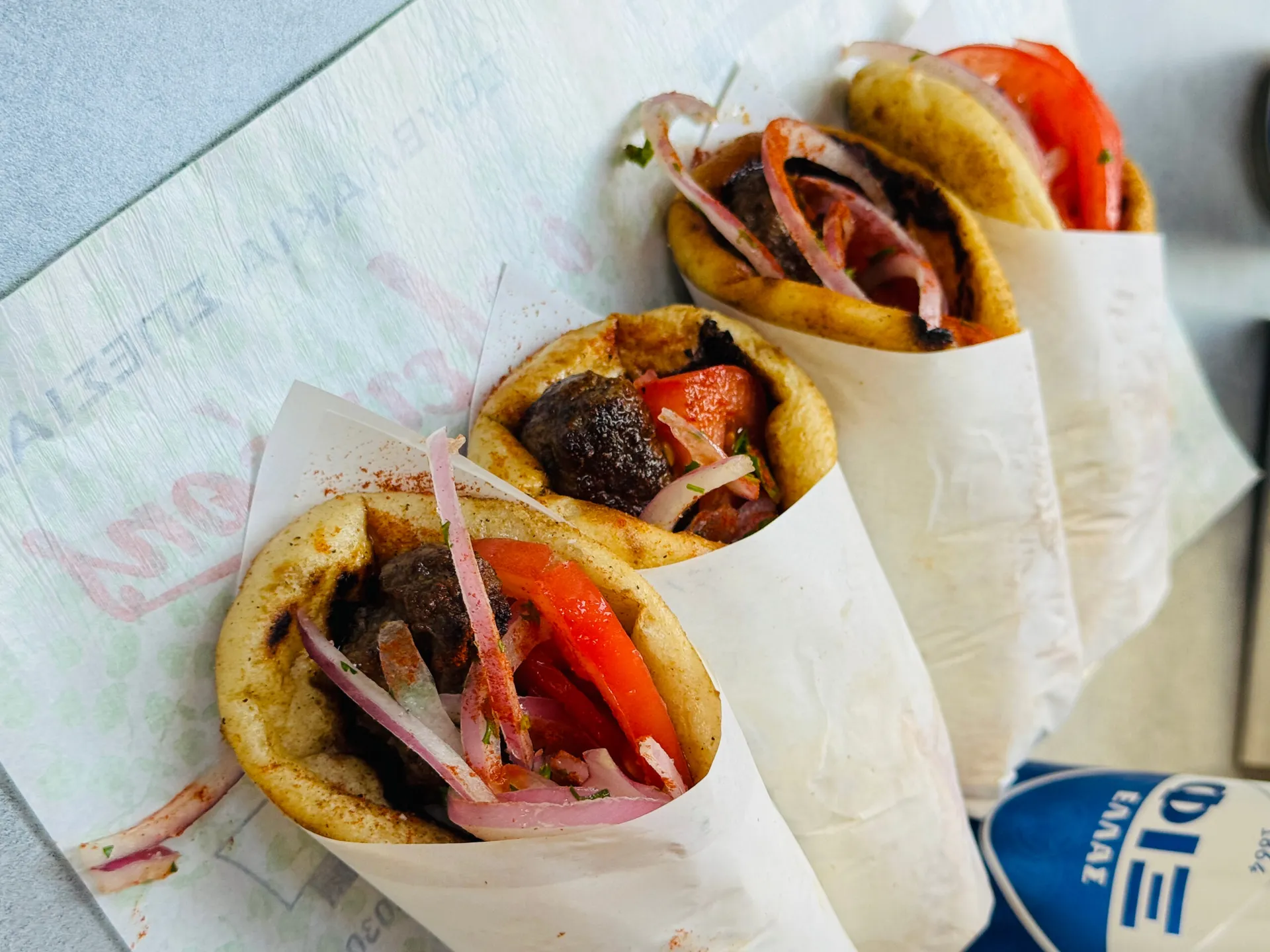
For seven decades, Lefteris's philosophy has remained the same: authenticity without compromises. The menu is deliberately sparse because value lies in simplicity. Minimal but selected ingredients: beef kebab, fresh tomato, onion with parsley, and a pinch of red pepper. Nothing more, nothing less.
The absence of potato or sauces isn't random. It's a conscious choice that lets the kebab's taste take center stage. A handmade patty grilled so it stays juicy and full of aroma.
Kebab preparation is an art in itself. Every morning the meat is freshly ground, without additives and without preservatives. Mixing is done by hand, with technique passed down from generation to generation. The meat must have the right consistency, not too tight so it doesn't become hard, but not too loose so it doesn't fall apart when grilling.
Grilling is perhaps the most decisive stage. The kebab is grilled at the right temperature, with the "master" knowing when to turn it, when to move it from the fire, and how to place it on the pita to retain all its juices. Each pita is grilled briefly with the kebab, absorbing taste and aroma. The pita itself is special: with the right density and taste to bind with the meat. Neither too thick to cover its taste, nor too thin to tear. Fluffy and delicious.
The tomato is cut into slices at the time of order, keeping its freshness and crunchy texture. The onion is finely cut and mixed with chopped parsley, making a salad that balances the meat's full flavor. The red pepper added at the end is a traditional spice blend reminiscent of Constantinople's markets, with their colors and aromas.
When the founder, Stavros Savvoglou, decided to hand over the shop's reins to the next generation, his choice was clear. His son, Lefteris, had grown up in the shop, learning the craft from childhood. He'd seen his father work from morning until late at night, caring for every detail, showing the same respect to every customer.
Lefteris understood tradition's importance and his responsibility toward the thousands of people who trusted the shop's taste and quality. When he took over management in the late '70s, he made a personal promise: his father's recipe wouldn't change.
This decision wasn't easy. In the years that followed, trends in fast food changed. New ingredients appeared, new techniques, different serving methods. Many competitors added potatoes, sauces, and various types of meat, seeking more customers.
Lefteris remained true to the original philosophy. "If I change the recipe," he used to say, "I won't be Lefteris o Politis anymore. I'll be one of many." This stance, which initially seemed to some conservative or even risky, proved over time to be his greatest strength. Today, the shop is in the third generation's hands, with Lefteris's son, Tasos, having taken the reins.
This recipe, which remained unchanged for decades, has united thousands of people around it. From workers and students to artists, famous or unknown, and travelers from around the world, Lefteris became a reference point for every social group, for locals and visitors.
And this isn't random. At Lefteris, everyone is equal before taste. There are no separate seats, no privileges. Everyone waits their turn and everyone gets exactly the same product.
Within this simplicity, a special community was born. In the queue, conversations start among strangers. The grillers and wrappers throw out a word, a comment, a joke. And when the moment comes to order, the person behind the counter looks at you through the mirror and wraps your souvlaki with care, with genuine taste and memories.
There are people who have visited the shop for three and four decades, having brought their children and now their grandchildren to taste the same flavor they enjoyed in their youth.
Common Questions
Where do Athenians actually eat?
Not where you think. The best spots are in Koukaki, Kypseli, and Exarchia — neighborhoods with no famous landmarks, just honest tavernas where the owner's mother is probably still in the kitchen. Stay away from anything with photos on the menu within 300 meters of the Acropolis.
Should I book a food tour in Athens?
If it's your first time, yes — and not just any tour. I run a private food walk that covers Monastiraki, the Central Market, and Psyrri with 10+ tastings. But even if you don't do mine, do one. Athens food culture is layered and a good guide saves you days of figuring it out alone. See my best Athens food tours comparison.