The afternoon sun scattered across the waters of the Saronic Gulf when we arrived at Isthmia By food journalist Dimitris Stathopoulos.
The afternoon sun scattered across the waters of the Saronic Gulf when we arrived at Isthmia. It was a significant day, not only for the experience awaiting us, but also for the reason that brought us there. Loutraki had just been certified as the first city in Greece to receive the honorary title of Culinary Capital from the internationally recognized World Food Travel Association.
This important distinction ranks Loutraki among the world's top gastronomic destinations, confirming the city's ongoing commitment to preserving, promoting, and advancing its authentic local culinary identity. As part of Taste of Loutraki 2025, a series of events was organized to celebrate this success, culminating in a crossing of the Corinth Canal.
The brief award ceremony in Loutraki took place by the sea, with the mythical canal we were about to experience as the backdrop. The speeches of officials echoed in the air, charged with the pride of a city that saw its gastronomic traditions recognized internationally. However, the real magic began when we boarded the Anna 2 ship.
A Festive Atmosphere on Deck
A festive and relaxed atmosphere prevailed on deck. The organizers had transformed it into an authentic celebration space. Music that embraced the place and the sea filled the air, while aromas from live cooking demonstrations reminded attendees why Loutraki deserved this distinction. The atmosphere was absolutely pleasant, with passengers sharing anticipation for the journey that would follow.
I found a spot on deck where the view was ideal. We all waited with a barely perceptible impatience. The ship started calmly, and in a few minutes we were entering the narrow line of the Canal. When the walls began to close around us, no one felt the need to speak. There was something sacred about this experience: like passing through the pages of History.
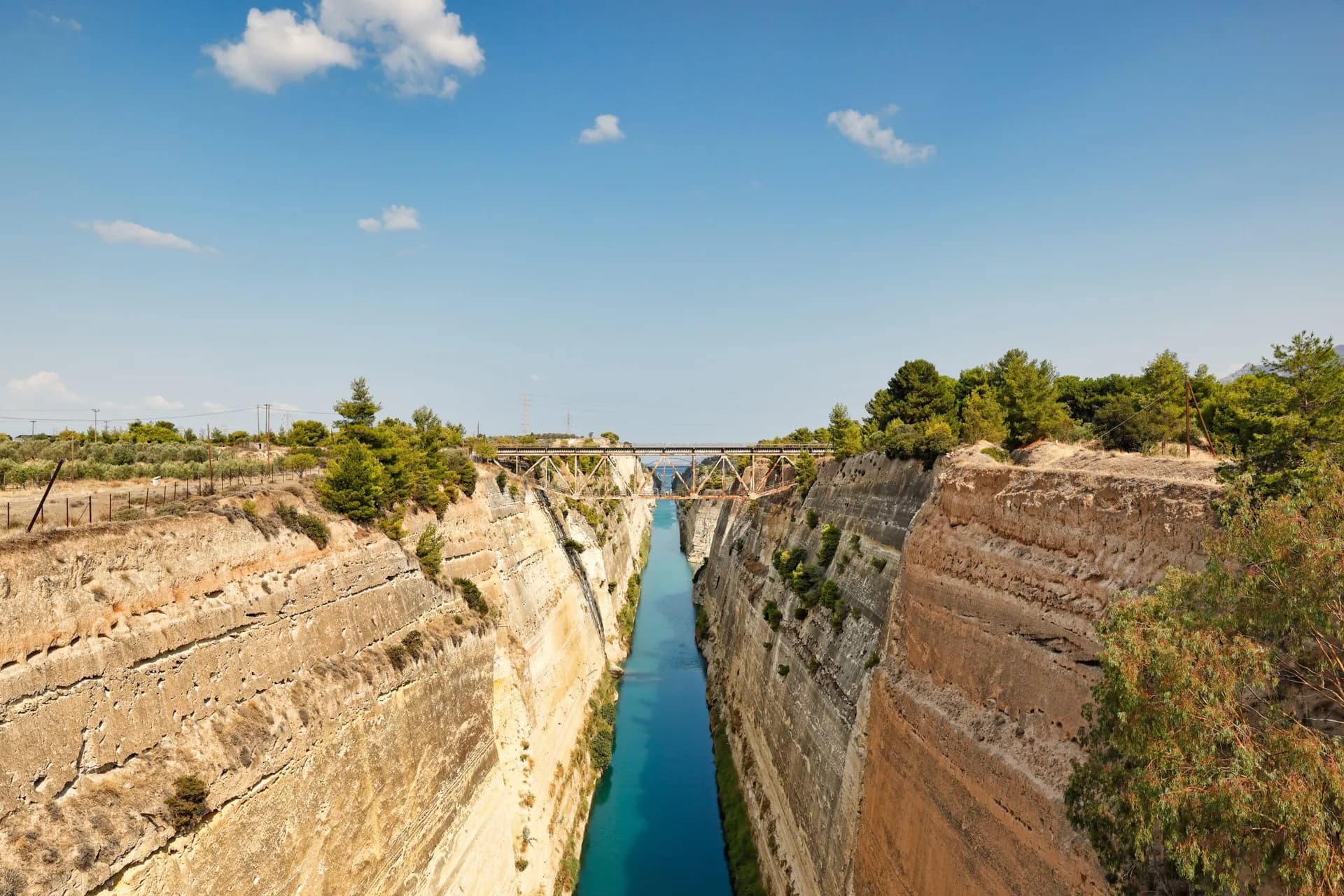
Hundreds of times I've passed over the bridges from above, or seen it from the airplane, viewing the canal as a narrow gash in the earth. Now, for the first time, I was observing the bridges from below, inside this artificial passage that humans carved into the rock. The walls rose steeply toward the sky, reaching up to 295 feet, but they didn't cause a feeling of claustrophobia. The 69-foot width seemed to have the ideal dimensions for this experience.
Nature Reclaims the Space
What impressed most was how nature had found a way to colonize even this artificial environment. Clinging to the canal walls, wild plants and small trees had found the opportunity to sprout, like a reminder that nature never completely surrenders to human intervention.
The exit to the Corinthian Gulf offered a moment of respite and reflection. The ship made its scheduled turn, and there I truly realized the magnitude of this work. The Corinthian Gulf stretched before us, with mountains silhouetted on the horizon. Behind us, the narrow passage of the canal seemed to have disappeared into the landscape. Here, we could appreciate the real significance of this project. For centuries, ships were forced to circumnavigate the Peloponnese, facing the dangers of treacherous capes. Now, these 3.9 miles offer a safe passage that saves days of travel.
The Return at Dusk
The return to the canal at dusk offered a completely different experience. The sun had begun its descent to the west, and its golden light fell obliquely on the walls, creating a play of shadows and colors that constantly changed. The bridges, which a few hours earlier seemed like simple structures, acquired a mysterious, almost theatrical presence in the twilight light.
The human eye struggles to capture the complexity of this landscape. Here, ancient ambition and modern technology meet, nature and human ingenuity, past and present. Every meter of this canal carries stories, from Periander who envisioned it in 602 BC, to Nero who gave the first strike with a golden axe, and from Ioannis Kapodistrias who brought it back to the forefront, to Andreas Syngros who finally completed it in 1893.
Today, more than 15,000 ships from 50 different countries cross this narrow passage every year. The canal is a living organism that continues to serve international trade, exactly as our predecessors envisioned. As the ship approached the end of the journey, thoughts returned to the reason that brought us there. Loutraki, with its certification as Culinary Capital, joins this place's long tradition of pioneering and innovating. Just as the canal opened new routes in navigation, so this new distinction opens new horizons in the gastronomic recognition of the place.
Crossing the Isthmus of Corinth is an encounter with human ambition, a dialogue with history, and a reminder that great works are born from dreams that take centuries to realize. In the waters of this canal, past and present meet and create a unique journey that no one should miss.
Frequently Asked Questions
What makes Greek food unique?
Greek cuisine is built on simplicity and quality ingredients. What makes it distinctive is regional variety — every island and mountain village has its own flavors, often unchanged for centuries.