The current owner, fifth-generation proprietor and architect Dimitris Ioannidis, speaks with travel By food journalist Dimitris Stathopoulos.
The current owner, fifth-generation proprietor and architect Dimitris Ioannidis, speaks with travel.
Heating chambers, ground floors, wood-carved ceilings, and European chandeliers. Sustainable architecture and building outlines. A stunning mansion that's a century and a half old tells the story of Zagori, speaks of Greek merchants' movements, the European influences on Epirus, early 20th-century medical care, the Greek middle class and its dreams.
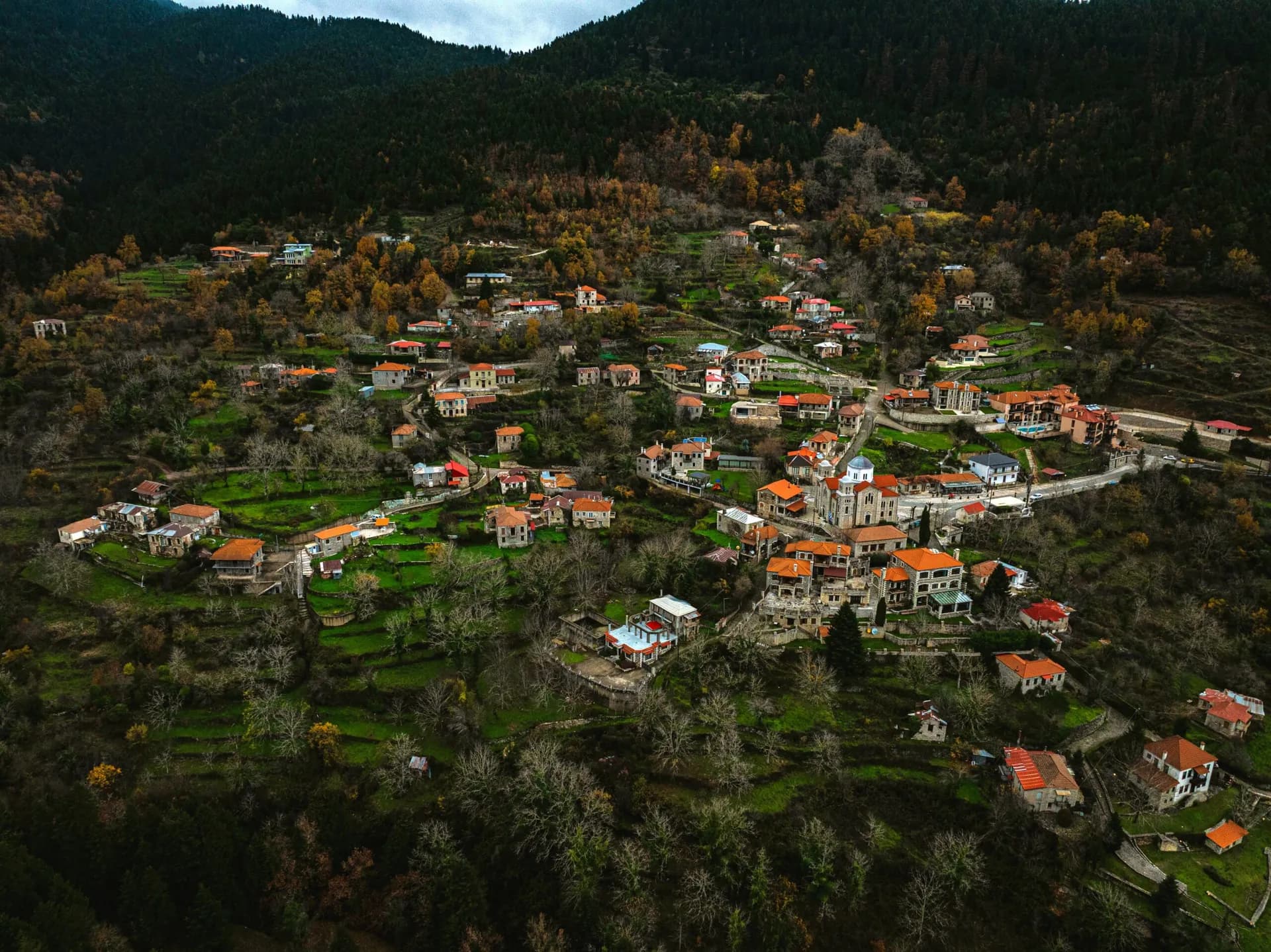
The current owner, fifth-generation proprietor and architect Dimitris Ioannidis, speaks with travel about his relationship with Zagori, architecture, and the mansion that came into his hands. He stubbornly envisions the future of a house-museum and opens fruitful dialogue with our architectural heritage. During a visit-experience in Tsepelovo, he opens the mansion for a photo shoot centered on the house's own history, through its objects and spaces. Among other things, the visit to the space used as a medical office is an experience in itself. Medical instruments of the era, old images, historic medical books, and a series of other things put you through a sequence of surprises and revelations.
What are the dominant elements of local architecture incorporated into the mansion?
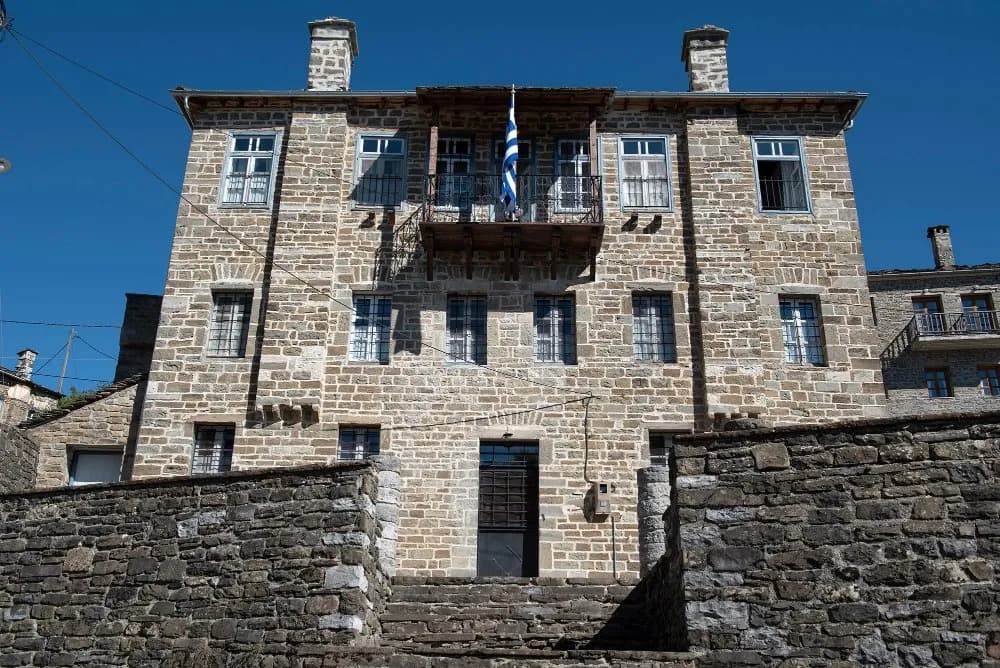
Like all traditional houses in the area, the mansion was constructed with stone and wood. It's a two-story residence with a ground floor, but due to the slope it gives the impression of being three stories. The first floor is the "winter" one with lower ceilings and smaller openings to heat more easily. The second is the "summer" one, with higher ceilings and larger openings for ventilation. The ground floor was formerly a space for animals and food storage, while now it's used as an exhibition space. The roof is covered with slate, as the Zagori decree requires. The frames are wooden, with iron bars, but without interior shutters, the so-called "kanatia," which had been removed by earlier generations of owners. The house has 5 fireplaces.
A tall stone wall surrounds the mansion, a protective element necessary for the era when the house was built, due to frequent raids by bandits. A special feature is the so-called "katachystra" or "zematisitra," an opening in the wall above the main door of the house, through which they poured boiling water on would-be robbers. Finally, an extremely important and rare element in the house is the existence of a medical office, which was created in 1894 when the Tsepelovitis doctor Anastasios Liapis married into the house, marrying Angeliki, the younger daughter of the builder Filippos Kousidis. The medical office functioned as the only one in the area for almost half a century. To this day it remains intact, with its tools, medicines, and books.
Are there elements of cosmopolitanism we find in the mansion?
The building's architecture belongs to the style of the urban neoclassical house and not to a typical Zagorian house of the Ottoman period. In the late 19th century, influences from Europe and the Danubian countries were already very evident in both architecture and clothes, decoration, and education. The freedom of movement and trade that the Zagorians enjoyed allowed and developed these influences. This is precisely the element we want to showcase and maintain in this house-museum: the urban cosmopolitan culture that existed in Zagori, alongside livestock farming, agricultural cultivation, and traditional professions.
Tell us something about the house's history.
The mansion was completed on July 10, 1876, by a group of builders (bouluki) from Pyrsogianni, as an inscription on the facade informs us. The original builder was my great-great-grandfather Filippos Kousidis, a Tsepelovitis landowner with estates in Grevena. With his wife Efrosini they had 4 children, two boys and two girls. The house passed as a dowry to the younger daughter Angeliki when she married doctor Anastasios Liapis, who set up his medical office inside the house. From their marriage they had one daughter in 1896, my grandmother Efrosini (Froso) Liapi. My grandmother kept the house alive even after her marriage to the Ioannina printer Ioannis p. St. Ioannidis, living between Ioannina and Tsepelovo. In 1928 my father Stavros-Anastasios Ioannidis was born. When my grandmother died in 1986, my parents proceeded with a major and careful restoration of the mansion. My mother, although a daughter-in-law from Athens, loved the house and cared for it like her own child, something she continues to do even today. Now the responsibility of preserving the house for future generations falls to me.
Has the house's life been connected with any historical events?
I wouldn't say the house's long journey is connected with any very significant historical event. A historical element is that during the civil war, partisans lived in the house, as they did in many other houses in Zagori. And of course, my grandmother Froso Ioannidou (1896-1986), called the "Mother of Zagori," was born and lived in the house. This title was honorably awarded to her by the Athens Zagorians Association in 1973, for her struggle in the war of 1940 and for the charitable works she offered to her homeland.
What connects your decision to become an architect? Was this decision connected to the fact that you inherited the mansion?
The connection is absolute between my desire to become an architect and the existence of this house. The experiences created for me from my childhood years when I spent summers with my grandmother in the village, and at an older age when I got to know all of Zagori, are etched inside me. From the first years of my studies I knew I would deal with traditional architecture and cultural management, and this influenced all my choices in both academic and professional space. Now I believe that for the rest of my life I will be devoted to my homeland.
What is your most intense spatial experience? Tell us about a space or building that you felt functioned decisively on you.
I still remember my entrance to the Church of the Resurrection in Jerusalem. I still feel intensely a wave of energy that overwhelmed me as soon as I crossed the threshold of this stunning space. Or the first time I visited the Neue National Galerie in Berlin, the last work of the iconic modernism architect Mies van der Rohe, a building housing modern art collections that literally appears to float. But also the view of Vikos from the Oxya or Beloi position takes my breath away every time I climb up to enjoy it.
Sustainable architecture and architectural heritage in the Zagori villages. How do you position yourself on this?
Traditional architecture is by nature sustainable and energy-efficient. Construction materials are selected from those available in the settlement's area, construction techniques are based on local knowledge, thick walls "hold" heat in winter and coolness in summer, heavy slate roofing ensures insulation. Of course all this requires maintenance, effort, and cost, things not easily provided today by owners, especially without the support of state agencies.
Modern constructions in Zagori, as elsewhere, are almost entirely concrete with stone and slate cladding, a facade of "traditional" architecture with no incorporated element from traditional knowledge. Unfortunately, I believe this course is irreversible. Beyond new constructions, however, our great concern and struggle must be in maintaining the old ones, in the most genuine and authentic way possible. We owe it to our own and future generations to preserve and pass on this wealth of tradition as intact as possible.
If you had to preserve one and only element of the architectural heritage of the Zagori villages, what would it be?
Respect for the maximum permitted height and area in constructions. It's unacceptable for buildings to sprout up in size and volume that don't align with the area's character. And of course, respect for settlement boundaries. Zagori has managed until now to maintain construction within settlements, but lately we observe attempts to extend settlement boundaries even at the expense of the Vikos-Aoos National Park boundaries and NATURA areas. Altering Zagori's character will be catastrophic and irreversible. If we allow overdevelopment, we will destroy Zagori's comparative advantage: the harmony between its natural and built heritage.
What is the mansion's future? How do you see it evolving over time?
My family's goal is for the mansion to be maintained in the best possible way and to always remain as a house, meaning it will never be converted into a guesthouse or given another use. We want the house to be visitable, in an informal and free manner, belonging to the type of museum houses we encounter very often abroad. In other words, to become a house-museum, a museum of itself through which a part of Zagori's history is narrated. This has already begun to take shape with display cases in the ground floor spaces, with the decoration of all the mansion's spaces with genuine, authentic furnishings (as much as possible), and the preservation of the medical office, intact with all its elements.
A tradition of my family was from the past the collection of valuable old objects, objects we now call "antiques" but which were once simply everyday items. The objects are exhibited as a five-generation family collection, a collection we hope to continually enrich.
Frequently Asked Questions
What makes Greek food unique?
Greek cuisine is built on simplicity and quality ingredients. What makes it distinctive is regional variety — every island and mountain village has its own flavors, often unchanged for centuries.