We visited the capital of Evrytania, a hospitable and vibrant town By food journalist Dimitris Stathopoulos.
We visited the capital of Evrytania, a hospitable and vibrant town.
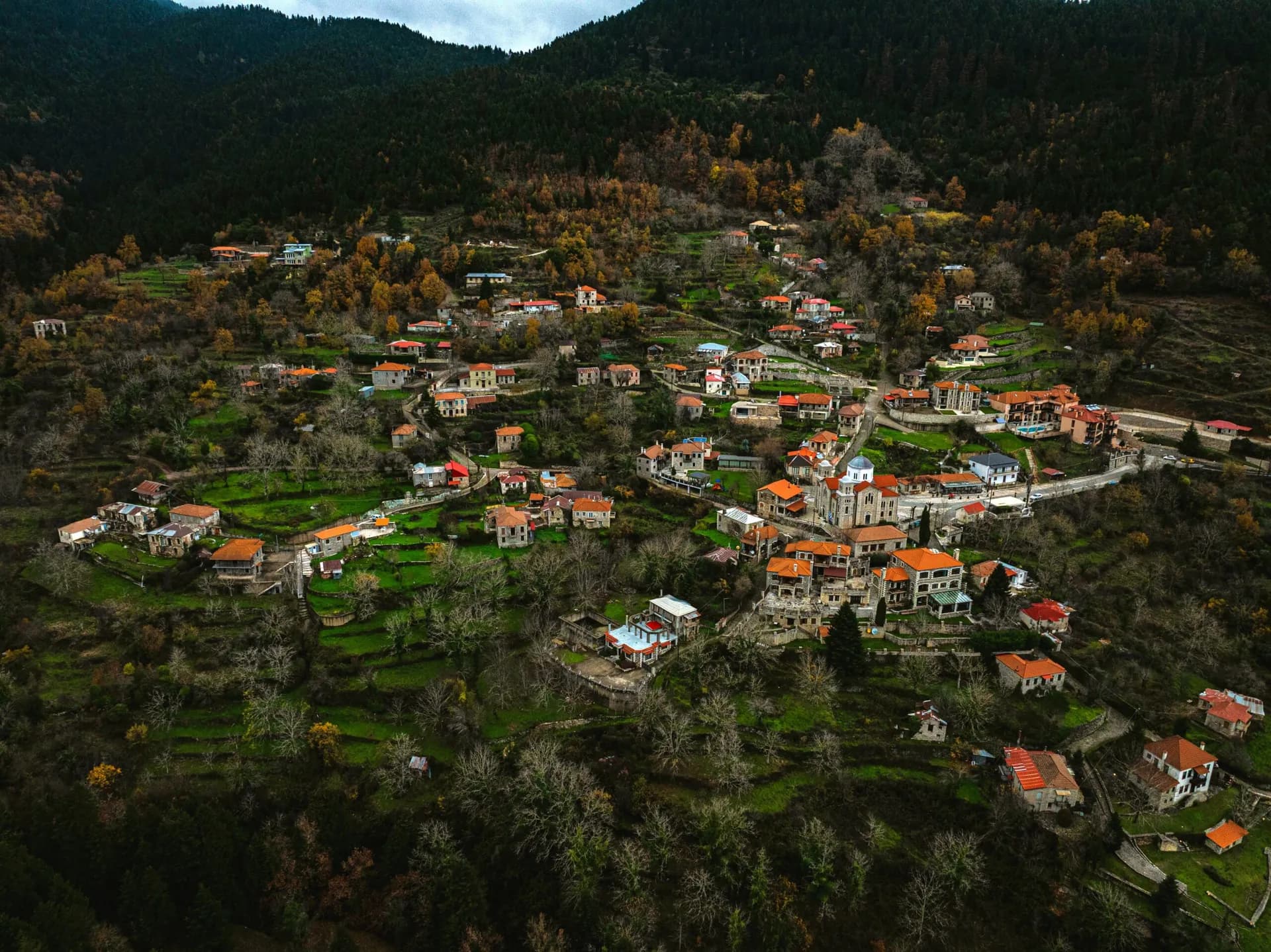
We arrived on the outskirts of Karpenisi late afternoon, a few days before Christmas. The fog was thick and the temperature just above zero. The car climbed the final turns through the fir forest as the landscape changed noticeably from the Fthiotida plain to the mountainous terrain of Velouchi. At 960 meters altitude, built amphitheatrically on the southwestern slopes of Tymfristos, Karpenisi has made winter part of its life.
I left the car near Zinopoulou Street, the main road crossing the town. Shop windows gleamed. The atmosphere smelled of cinnamon and mastic. A shop with amber honey from the surrounding Agrafa mountains caught my attention. Grocers with herbs and local products alternated with modern clothing and technology stores. People walked quickly on wet sidewalks, their breath forming small clouds. The town: alive, dynamic, modern.
Heading toward the square, I met two men slowly climbing the road. Taxiarchis and Kostas, childhood friends, born and raised in Karpenisi, genuinely hospitable, stopped to talk. "Welcome to Karpenisi," Taxiarchis said. "Our town is at its best these days. The holidays bring people, bring life."
They invited me for a Greek coffee at a traditional café. There, as the coffee's aroma filled the atmosphere, they spoke about their town. "Here people have learned to live with the mountain, not fight it," Kostas told me. "Winter is our season. What others fear, we embrace." Life here was difficult but happy. Difficulty was part of the agreement with it.
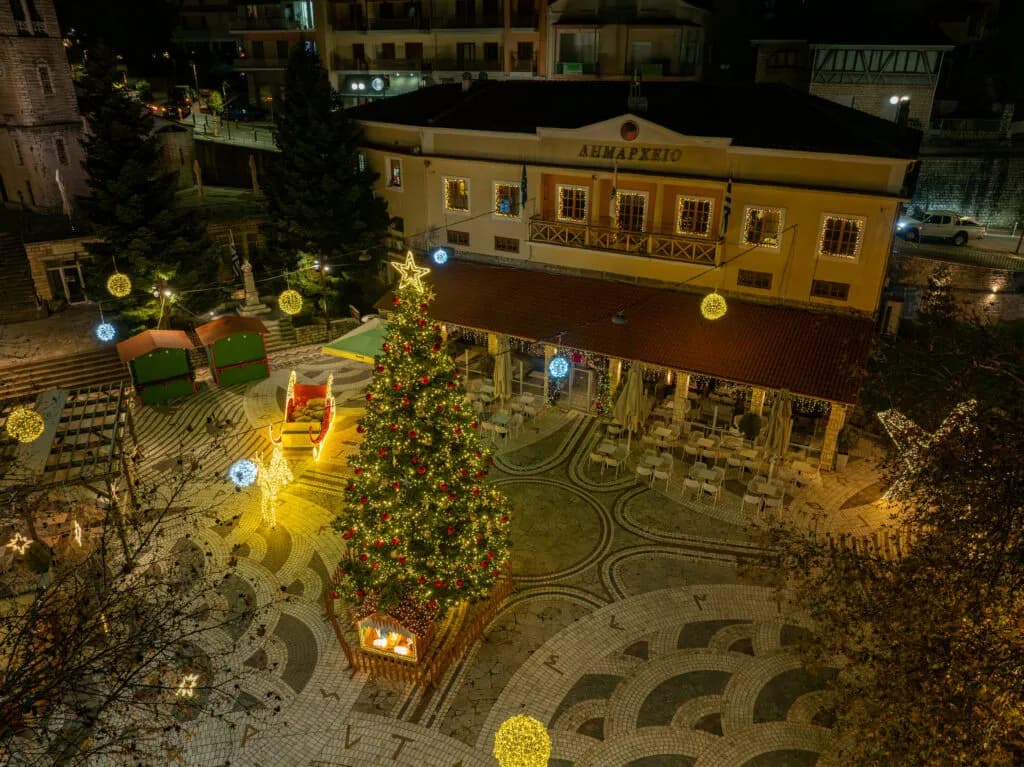
I bid farewell to the two friends and descended to the central square. The stone floor was wet and reflected the lights hung above the old plane trees. Even without leaves, the trees dominated the space, their large trunks reminding how many years of life have passed here. The square functions as a main meeting point for residents and visitors. In traditional cafés with foggy windows sat elderly men, observing the square's activity.
Next to them, more modern cafés buzzed with young people: conversations about evening outings, holiday plans, laughter. This coexistence of past, present, and future, tradition and modernity, says much about today's Karpenisi. At the square's lower section, a stone fountain with five marble lion heads ran abundant, freezing water. And on the floor, marble slabs mark Evrytania's old municipalities, like a map reminding where everything started.
The municipality organizes an annual rich "Winter Festival" program lasting from early December through Epiphany. Concerts in the square, children's activities with Christmas workshops, traditional events reviving the area's history. The climax comes on Christmas Eve with the "Night of Wishes," where thousands of biodegradable lanterns release simultaneously into the sky, carrying wishes and hopes. The spectacle of illuminated points disappearing into the night, against Velouchi's dark peaks, is stunning.
On December 26th, Zinopoulou Street closes and transforms into a large dance floor for the Street Party. DJs, warm drinks, and dancing give the town a youthful, unexpected energy. On New Year's Eve, carols fill the square, while on January 6th, the blessing of the waters takes place at Palio Mikro Chorio's small lake. Beyond organized events, tradition continues in homes through customs like preparing Christopsoma bread.
Walking in Karpenisi, one can hardly ignore history's weight. Just three kilometers from the center, Kefalovriso, today a recreation area with huge plane trees and running water, was the scene on the night of August 8-9, 1823, of one of the Revolution's most daring battles. Here fell Markos Botsaris, attacking Mustafa Pasha's camp. His death passed him into the realm of legend and connected Karpenisi forever with the 1821 Struggle.
Evrytania was a bastion of National Resistance. In nearby Koryschades, the historic school hosted the 1944 sessions of the National Council of the so-called "Mountain Government." Today, the building operates as a National Resistance Museum, keeping those days' memory alive. Karpenisi paid a heavy price when burned by Germans in August 1944. The ensuing Civil War, with the town's occupation by the Democratic Army in 1949, left even deeper wounds. Each time, the town rebuilt. People stayed. Mountains remained. Today's Karpenisi image results from this continuous restart.
Exploration doesn't stop at the town. Surrounding villages, nestled on mountain slopes, are guardians of architectural tradition. Palio Mikro Chorio was reborn after the January 13, 1963 landslide that crushed most of the settlement and led to 13 deaths. Surviving houses have been restored respecting traditional architecture, functioning as guesthouses and restaurants.
At the village entrance, the small lake created by the disaster, framed by willows and plane trees, constitutes a monument to nature's power but also the beauty that can emerge even after tragedy. Opposite, at Kaliakouda's foothills, sits Megalo Chorio, a stone-built jewel with cobblestone paths prohibiting vehicle traffic in the center, maintaining tranquility and traditional aesthetics. Koryschades, closer to Karpenisi, impresses with its mansions and historic square, offering a journey through time.
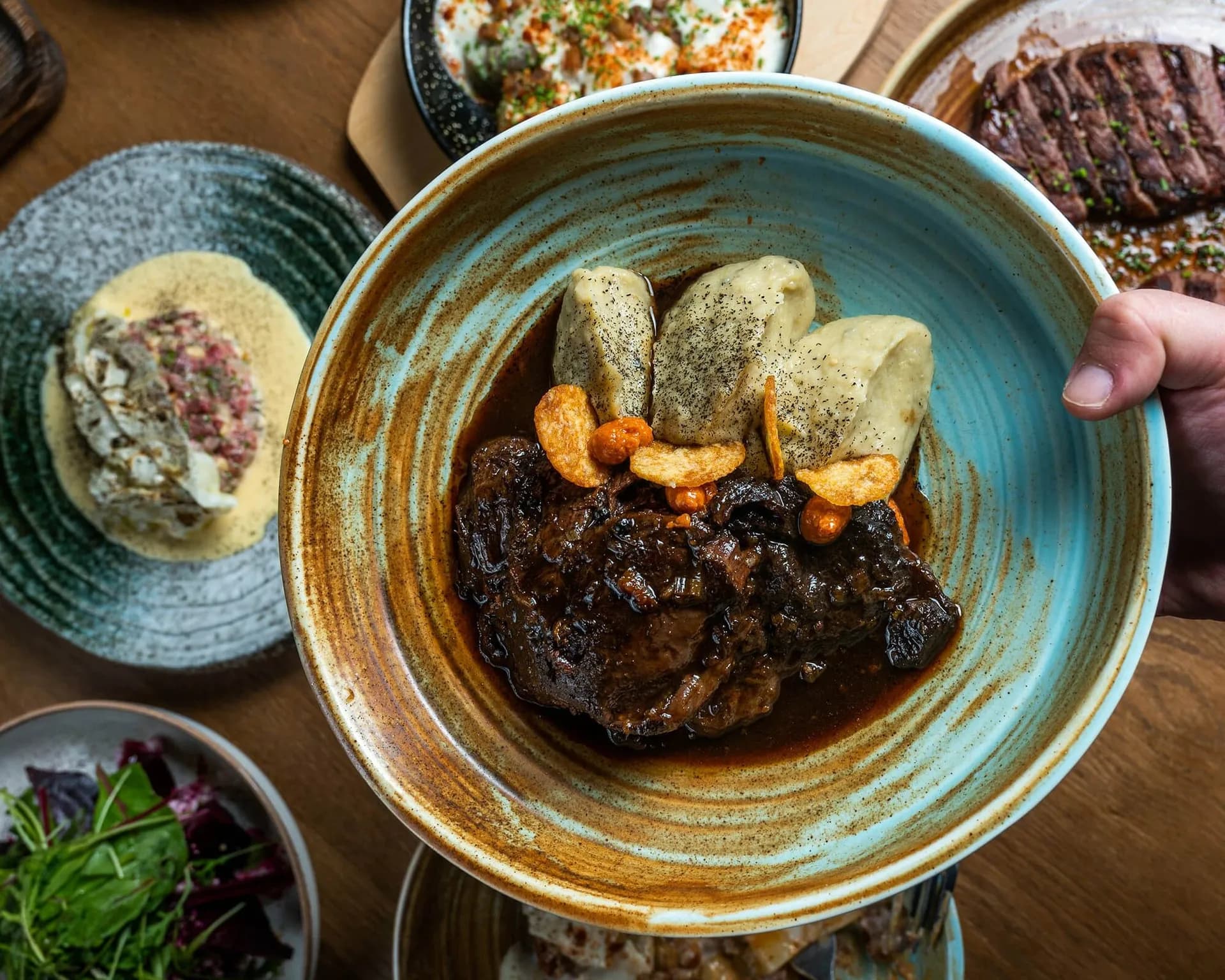
A visit to Karpenisi is completed only through taste. In area tavernas, the fireplace burns continuously, creating the ideal atmosphere to enjoy local dishes. Tsalafouti, Evrytania's PDO cheese, is creamy with a fresh, slightly sour taste. Produced from sheep's milk, it's the perfect spread for village bread. The area is famous for leek sausages and naturally aged prosciutto produced in Prousos, utilizing Agrafa's air.
In Gavros settlement, beside the Karpenisiotis River, you'll find fresh trout grilled or pan-fried with butter, directly from the fish farm. The experience of eating beside running water, hearing the river's sound, is unique. In Megalo Chorio, Karvelis's galaktoboureko has become legendary for its crispy phyllo and velvety cream, constituting a reason to visit on its own.
Before leaving, two more stops couldn't be skipped. The Evrytania History Culture Center, housed in the historic old Forestry building, offers a rare experience by Greek standards. Through virtual reality applications, visitors can tour the submerged Church of Episkopi, the Byzantine monument lost beneath Lake Kremasta's waters in the 1960s. Wearing special VR glasses, I found myself inside the church as it was before being lost, among frescoes and architectural details that no longer exist. It was like briefly opening a window to a piece of history remaining underwater.
A few meters down, the Mountain Museum, Greece's only one dedicated exclusively to mountains, tells another story. Displayed is authentic equipment from the first successful Greek Everest expedition in 2004: oxygen masks, suits for -40°C extreme cold, crampons and ice axes that reached the summit. There are also rare books and publications, plus Giannis Flegas's photographic archive, a skiing pioneer in the area, documenting the journey from first amateur attempts to creating the modern ski resort. The two museums function like two sides of the same coin: one guards past memory, the other honors present adventure.
The next day, just before leaving, I passed through Zinopoulou Street again. Shopkeepers opened their doors with the same familiar rhythm. The sky remained gray, the mountain hidden in fog. The town continued, as always, regardless of weather, regardless of conditions.
Karpenisi is a community that learned to live with effort, to build around forces it couldn't control, to endure fire, war, losses. Yet, it keeps its identity as a place where, as Taxiarchis and Kostas told me, life is difficult but happy.
A place where people persist in creating, even in winter, inviting us to become, if only briefly, part of their story. As the car descended Tymfristos and fog remained behind, the thought of returning arises spontaneously.
Journey to Karpenisi, in the heart of Evrytania
Escape to Megalo Chorio, a paradise in Evrytania's heart
Journey to Evrytania: Authentic way of life in a magnificent place
Frequently Asked Questions
What makes Greek food unique?
Greek cuisine is built on simplicity and quality ingredients. What makes it distinctive is regional variety — every island and mountain village has its own flavors, often unchanged for centuries.