An exceptional route with stops at places of extraordinary natural beauty By food journalist Dimitris Stathopoulos.
An exceptional route with stops at places of extraordinary natural beauty.
It's early morning in the heart of winter. I've arranged with Ilias Kosindas, the photographer who'll join me on this press trip to Grevena and later Kastoria, to start early and catch beautiful light at Portitsa Bridge. That was our plan for the first stop. We left very early indeed, with daylight's first glow finding us somewhere near Afidnes. During the drive, Ilias talks about one of the last "dark rooms" for developing black-and-white photographs that he maintains in central Athens, we discuss Spetses, his favorite island, and photography in general.
He keeps his camera ready, never missing an opportunity to point his lens at things that make him "click." Passing through Kalambaka beneath the towering rocks of Meteora, he's intrigued by the contrast between the bustling new town and the abstract yet imposing image of the rocks. The journey grows increasingly interesting as we approach the wider Grevena area, clouds making their appearance and creating beautiful shadows.
We cross the Venetikos River and the Ziakas Bridge. A brief stop in the Ziakas settlement, a few words with locals drinking coffee at the café. It's almost noon. We decide to approach the iconic Portitsa Bridge but choose a dirt road through Orliakas, Grevena's mountain, which will bring us to the spot while crossing a lush forest of enormous trees, primarily black pine. We stop repeatedly as the area's natural beauty is extraordinary. The route is relatively good, though it requires a vehicle slightly higher than usual, as water has created small grooves in some sections.
It's worth turning off the engine and listening to nature. It's a magical moment when you hear nothing but gentle wind gusts making tree leaves rustle, while some birds cross our horizon. We're in the heart of the forest. We've been instructed not to stray from the car. And that's what we do. It's a route you don't want to end. At one turn, a section of the beautiful village of Spilaio reveals itself. A bit further down, another view.
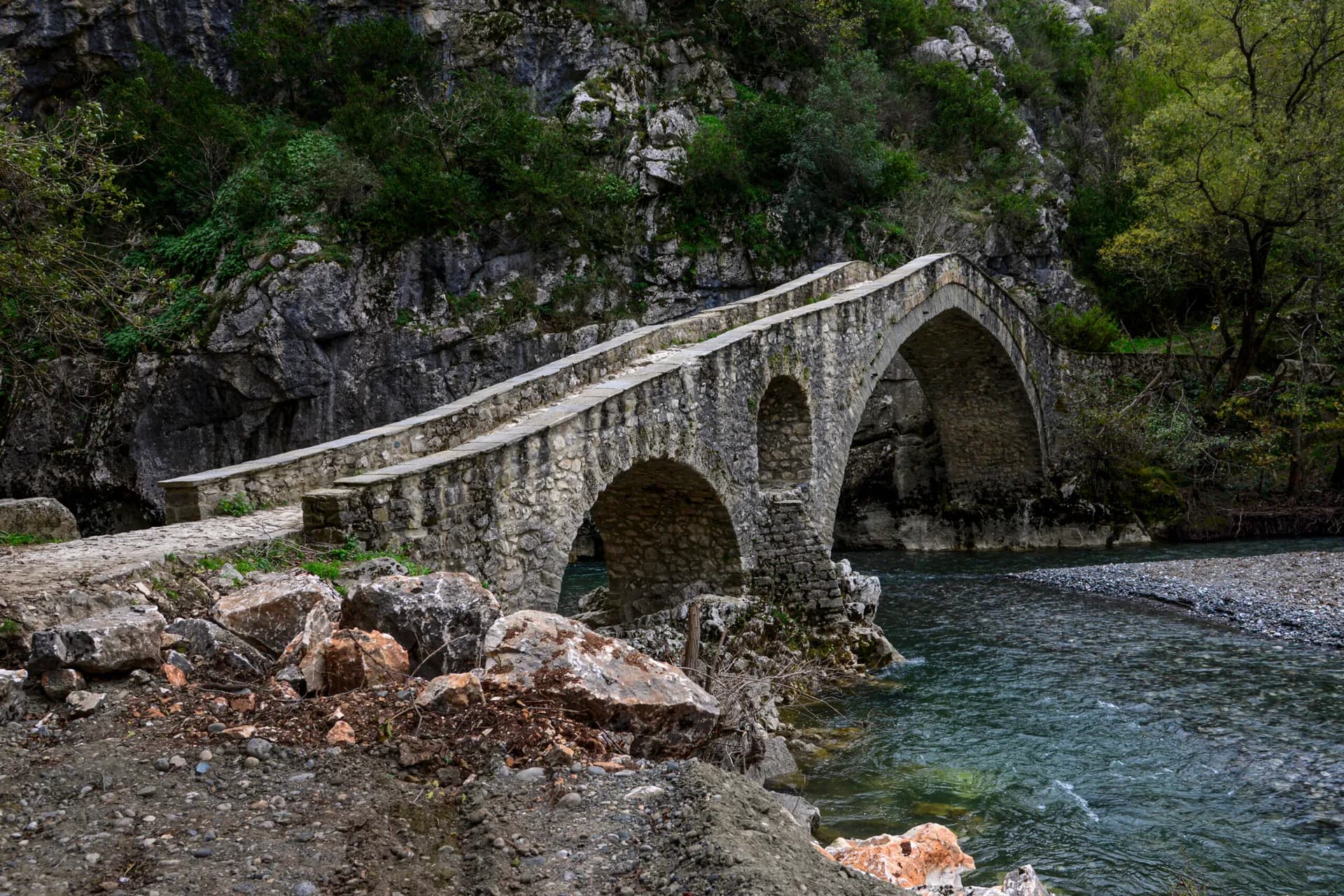
We arrive almost at the village entrance and take the downhill road to Portitsa Bridge. Heavy rainfall from recent weeks has clearly affected the riverbed's appearance. However, the gorge created by two vertical rocks, through which the Venetikos River flows, remains the highlight. This is especially intensified as the stone arched bridge, measuring 34 meters long and nearly 8 meters high, sits just meters from the imposing gorge.
Beyond its tourist appeal, Portitsa Bridge represents an important historical treasure, dating from the 18th century, estimated to have been built in 1743. Here, history meets nature, offering visitors a unique experience. Crossing the gorge in spring or early autumn happens by kayak, while summer offers a special experience for hikers. We spend considerable time here, choosing to walk a few meters on the trail that starts near Spilaio's Elementary School. It's 2 kilometers total, and you'll need about 45 minutes to reach here. Time to leave, and we follow the reverse route.
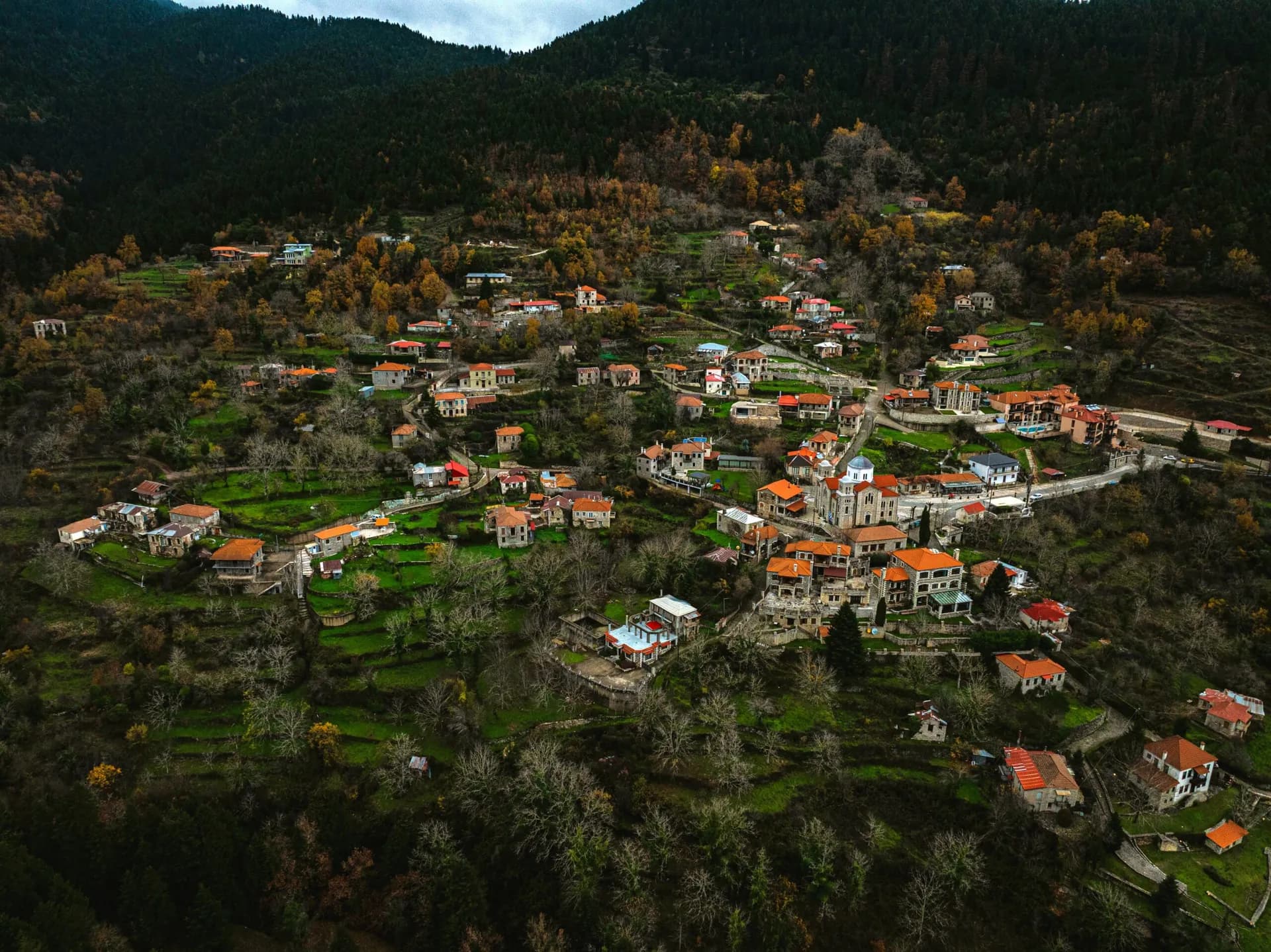
We arrive at the Spilaio settlement at nearly 1,000 meters altitude. It's started to drizzle, but at least for now we can walk around the village. We pass the stone two-story Elementary School, built in the early '30s and ceased operation in 1997, while just below sits Agios Athanasios church, built in 1804 and reportedly financed by Ali Pasha's secretary's wife. Next to this historic church stands another smaller one, Archangels, built in 1961.
We meet Giannis Vavritsa, the settlement president. He's active and ready to help however he can so we get the best impression of the village. He invites us for tsipouro at Zisis's taverna by the square. Almost continuously, he talks about the village, searches his phone to show us photos, and urges us to see other things around. Drinking tsipouro, we sample the wonderful meze that Zisis prepared.
Next, we leave for the historic Monastery of Dormition of the Theotokos, founded in 1633. Mrs. Anastasia Papaioannou is the person who'll open the monastery for us. She's a volunteer and, in coordination with responsible authorities, visits the site daily, allowing visitors to see this beautiful religious building inside. She also encourages us to publish her mobile number (6947 580412) so any visitor wishing to see and learn about this religious monument can make an appointment. It belongs to the Macedonian post-Byzantine era, while its architectural evolution appears in the spacious narthex and bell tower, additions enriching the original structure.
Walls built with rough stones and reinforced with hewn stones reveal diligence and devotion to detail, especially in the niches and two domes. Inside the church, frescoes dating from 1650 reveal the art of iconographers Nikolaos and Ioannis, while works by Michalis and Ilias in 1658, plus Georgios Pitenis in 1911, add layers of history and testimony. Seventeenth-century woodcarving works like the iconostasis, door, and windows compose a space where religious tradition and art meet history. The surrounding area is ideal for peace and relaxation. If you have some time, it's worth dedicating it to this.
Time to leave. We meet a local returning home. Spilaio's few permanent residents mainly engage in livestock farming and land cultivation. Beans, goat feta, and tsipouro constitute the village's most characteristic products. The president bids us farewell and invites us to visit Spilaio again in midsummer, on the Assumption, when a three-day festival honoring the Panagia monastery takes place in the central square around the plane tree, with local bands and traditional dances.
3 Road trips starting from Grevena
Journey to Grevena: Exploring two landmarks of an authentic destination
Xanthi-Grevena: What you absolutely must include in your travel itinerary
Frequently Asked Questions
What makes Greek food unique?
Greek cuisine is built on simplicity and quality ingredients. What makes it distinctive is regional variety — every island and mountain village has its own flavors, often unchanged for centuries.