A boutique space dedicated to extra virgin olive oil, Mediterranean gastronomy, and sustainable hospitality Insider guide by food journalist Dimitris Stath
A boutique space dedicated to extra virgin olive oil, Mediterranean gastronomy, and sustainable hospitality.
Saturday morning finds the sun gently caressing the hills of Messinia. In Filiatra, where the earth smells of history and ancient olive trees guard centuries-old secrets, I meet Christina Stribakos. Our meeting isn't random: we're in the grounds of the Byzantine Church of the Ascension, where the sacred meets the earthly, where faith embraces nature.
Christina welcomes us with her characteristic smile, accompanied by Dimitris and Martha. The cool breeze descending from Messinia's mountains feels like natural air conditioning, creating the ideal setting for what's about to follow. Dimitris offers us sesame koulouri: simple, authentic, perfect.
Entering the olive grove, the landscape transforms into a living canvas. Two thousand Koroneiki variety olive trees stand like silent guardians, their branches whispering stories beginning in 1975, when Christina's parents inherited the first nineteen trees. Today, this family legacy has evolved into an autonomous organism that breathes, produces, and exports Messenian olive oil LIA to the demanding markets of France, Belgium, and Sweden.
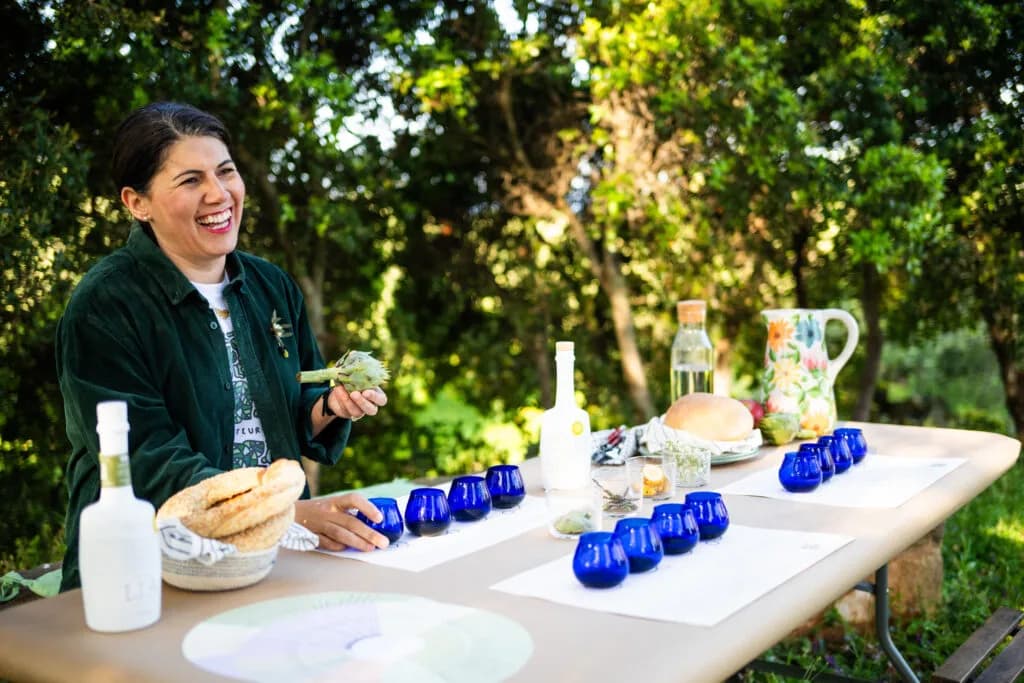
Christina has already prepared the tasting table beneath the shade of a centuries-old tree. The bottles gleam in the morning light, while their white packaging isn't merely an aesthetic choice but a strategic protection from light, keeping the contents' premium quality intact.
"Our trees aren't just memories of the past but tools of our inspiration for the future," Christina says, pouring olive oil into small blue glass cups. The olive oil immediately reveals its personality: medium fruity, balanced bitter and pungent taste, with notes of freshly cut green olive fruits conversing with aromas of green almond, artichoke, and fennel.
The tasting becomes a life lesson. Christina, an expert taster and judge at international competitions, takes us through the world of Greek olive varieties, explaining how climate, soil, and the producer's philosophy meet to create something unique. LIA, the olive oil she produces, has received numerous awards and been recognized as the world's best Koroneiki variety olive oil according to the World EVOO Ranking: a distinction that didn't arise from luck but from decades of dedication and love.
As the conversation evolves, it becomes clear that for Christina, olive oil is a culture bearer. Through the tasting programs she's offered for nine years, she's managed to transform each visit into an authentic experience connecting gastronomy with understanding sustainability and local production.
"Our Northern European visitors," she explains, "now seek something more than tourist experiences. They want to connect with the origin of products they consume, to understand the stories behind each bottle." This trend has brought to her olive grove not only simple tourists but also food professionals, olive oil devotees from abroad, even famous chefs seeking perfection in their kitchens.
In an era when globalization threatens to homogenize flavors, Christina fights to preserve Greek olive variety. Each bottle of LIA traveling to the shelves of La Grande Épicerie de Paris, Harrods, or Fortnum & Mason is an ambassador of Messenian land, Greek tradition, the philosophy that quality is created with patience and love.
In autumn, when the harvest brings visitors close to the production process, the experience becomes even more magical. "I think ultimately," Christina says, "what remains is the connection with nature and the product. When people leave here, they take with them a piece of this place's soul."
As Saturday morning flows toward noon and the cicadas begin their symphonic performance, I understand why Christina never thought to "give up" what she does. When your work is simultaneously passion, mission, and legacy, then it becomes a way of life. And in Messinia's hills, beneath the shade of centuries-old olive trees, this philosophy takes flesh and blood, transforming each drop of olive oil into a poem full of history, tradition, and love.
From September, the LIÁ Olive Oil Hub opens its doors in Filiatra. A boutique space dedicated to extra virgin olive oil, Mediterranean gastronomy, and sustainable hospitality. Created to host tastings, educational seminars, and experiences around the world of olive oil, connecting visitors and professionals with the true character and wealth of Greek land.
Journey to Messinia: Discovering Kalamari Waterfall
Journey to Messinia: Voidokilia, Glossa, Golden Beach: Diving into 3 heavenly beaches
Travel journey to Messinia: The travel virtues of Koroni
Common Questions
What is Messinia known for in terms of food?
Messinia produces some of Greece's finest olive oil, incredible figs, and a style of cooking that is simultaneously rustic and refined. The local kalamata olives you've been eating your whole life come from here — tasting them in their origin region is genuinely different. The tavernas in Koroni and Stoupa are among my favorites in all of Greece.
How do I get to Messinia from Athens?
It's a 3-hour drive south on the E65 — easy and scenic through the Peloponnese. The coastal road near Kalamata is particularly good. I recommend renting a car; public transport gets you there but won't let you explore the villages properly. Day trips from Athens are possible but overnight is much better.