Where the mountains meet the sea, you'll find a paradise that ranks among the most beautiful beaches in the world By food journalist Dimitris Stathopoulos.
Where the mountains meet the sea, you'll find a paradise that ranks among the most beautiful beaches in the world.
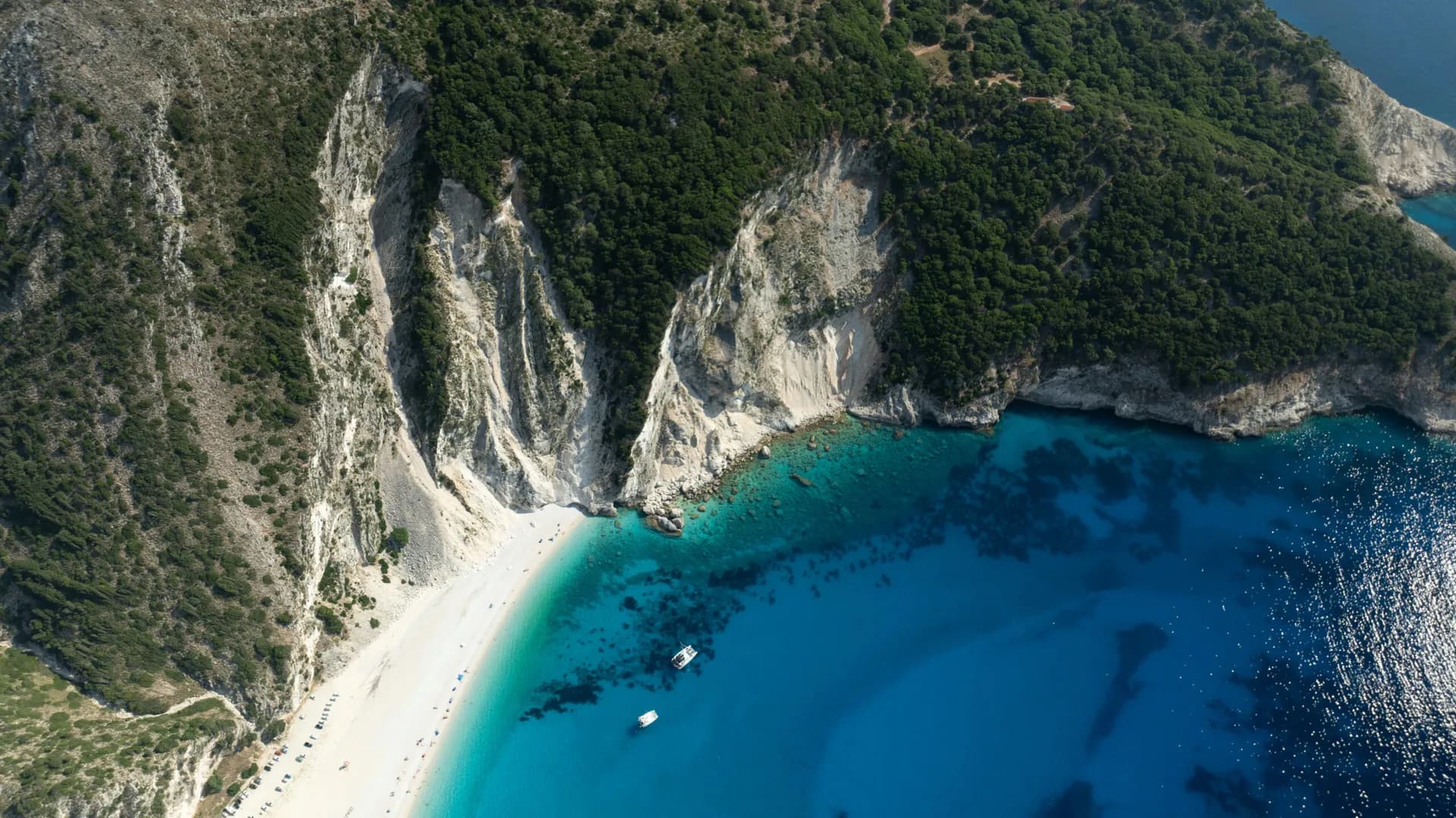
On the northwestern tip of Kefalonia, where mountains plunge into the sea, lies a paradise that has been ranked among the world's best beaches for more than a decade. The spiraling road descending from the mountain foothills to Myrtos is a journey of gradual revelation.
With each turn, the landscape unfolds like scenes from an epic work of art unrolling before your eyes. When you finally reach the beach's overlook, the view is breathtaking: a long strip of white sand and pebbles embraced by waters so clear and turquoise they resemble liquid crystal.
The beach stretches for over a kilometer, forming a perfect crescent framed by sheer white cliffs. The geological forces that shaped this natural amphitheater worked for millions of years, creating through tectonic subsidence a bay now considered one of the Mediterranean's most beautiful geological phenomena.
In this magical place, the voices of ancient myths still echo. Here, according to tradition, lived the Tritons, the mythical children of Poseidon, who enchanted passing sailors with their magical songs. The legend of the young shepherd Makris, who fell in love with the beautiful mermaid Kymothoe and transformed into a rock to remain forever by her side, gives the beach a romantic dimension that continues to inspire visitors.
Even the mythical Odysseus seems to have left his mark here, as tradition holds that Myrtos was a stop on his epic journey and the place of his meeting with Princess Nausicaa. Aphrodite, the goddess of love and beauty, had her own temple on the beach according to myth, making it a pilgrimage site for those seeking love and passion.
Myrtos's history isn't limited to mythology. During the Venetian occupation, the beach functioned as a natural harbor, facilitating trade in local products like Kefalonian wine and olive oil. In the 19th century, its strategic location made it an important commercial center for the island's northern side.
During World War II, Myrtos became the scene of dramatic events. In September 1943, the beach became one of the main landing points for German forces. At the same time, its isolated location and natural formation made it an ideal base for operations by the Greek resistance movement and Allied forces. Damage from military operations and air raids was significant, but the beach maintained its strategic importance until the island's liberation in 1944.
Today, Myrtos is part of Mount Ainos National Park, a protected area ensuring the preservation of its natural beauty. The beach is located about 30 kilometers north of Argostoli, and access to it, while demanding, rewards you with one of the Mediterranean's most spectacular panoramas.
If there's one moment when Myrtos fully reveals its magic, it's at sunset. As the sun sinks toward the horizon, the sky transforms into a canvas of orange, pink, and deep crimson hues. The colors reflect on the crystal surface of the sea, creating a breathtaking visual phenomenon. In summer, sunset lasts long enough to fully enjoy the transition from day to night, while in winter the cooler tones of the sky create a stunning contrast with the white sand and chalk-white cliffs. Visitors gather on the sand like pilgrims at a natural temple, enjoying one of the Mediterranean's most spectacular sunsets. The sound of waves gently breaking on the shore and the serenity that permeates the place create an almost sacred atmosphere.
Today, Myrtos continues to attract visitors from around the world, maintaining its place on lists of the world's best beaches. It's a place that once you experience it, you never forget. Its unique beauty, rich history, and mythological dimension make it an experience that touches the soul.
At Myrtos, Nature reveals its most refined form, reminding us why certain places on earth are considered sacred. Here, time seems to stand still and every visitor becomes part of a continuing tradition of wonder and respect for natural beauty that has inspired generations for thousands of years.
Frequently Asked Questions
What makes Greek food unique?
Greek cuisine is built on simplicity and quality ingredients. What makes it distinctive is regional variety — every island and mountain village has its own flavors, often unchanged for centuries.