From above, the Messolonghi salt flats look like a giant abstract painting that transforms with every shift of light Insider guide by food journalist Dimit
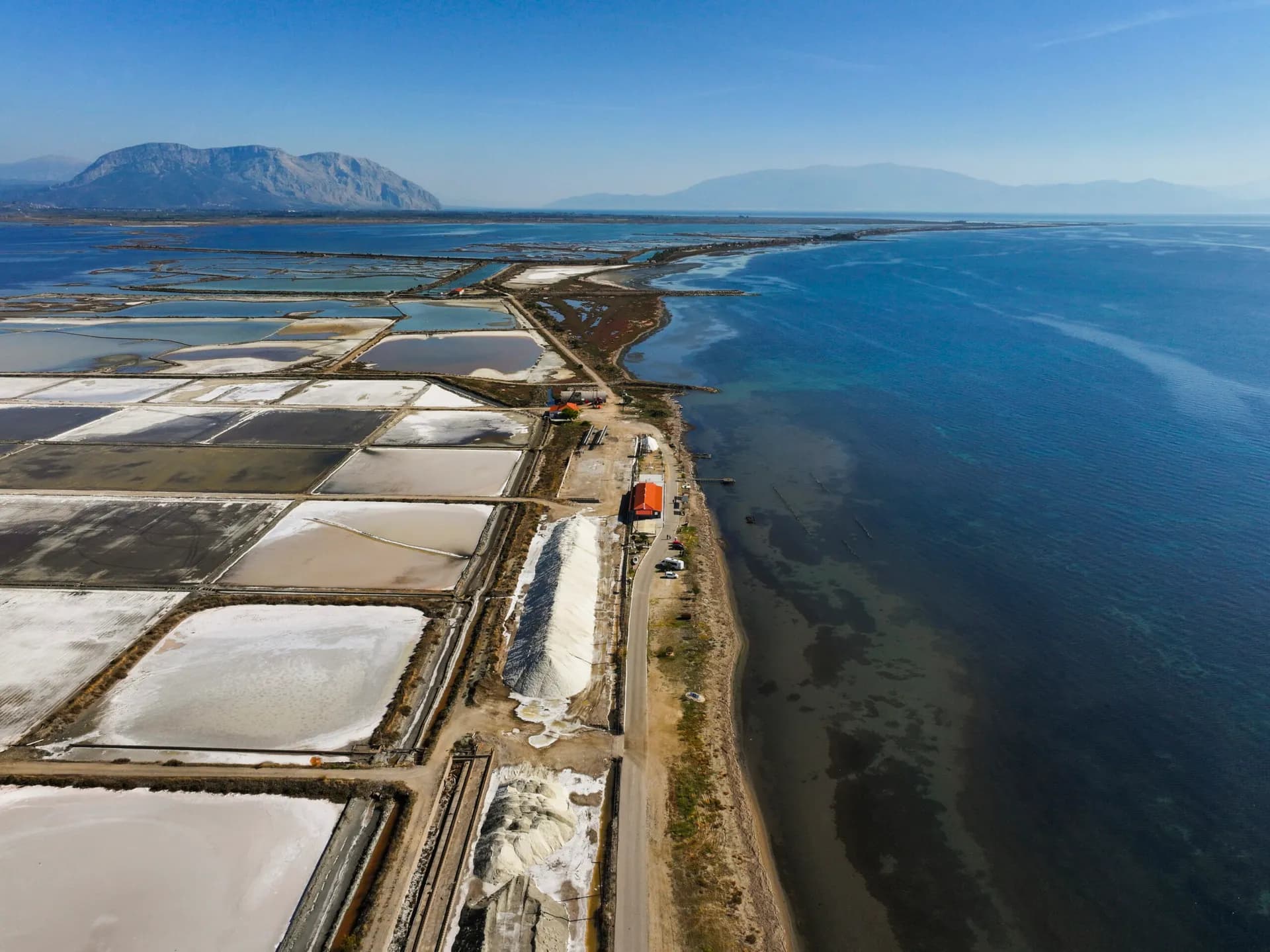
From above, the Messolonghi salt flats look like a giant abstract painting that transforms with every shift of light. The aerial view reveals a mesmerizing kaleidoscope of colors: turquoise lagoon waters meet golden salt pans, while white salt crystals create a dazzling contrast against the deep greens of coastal vegetation.
Crossing the old national road from Messolonghi to Aitoliko, visitors encounter a sight that seems to defy the laws of nature: white mountains rise beside the sea, not from snow, but from salt crystals glistening under the Mediterranean sun. These mounds, reaching up to 15 meters high, are the result of a traditional process dating back to the 14th century.
The region hosts Greece's largest salt production complex, consisting of two units: the state-owned facility covering 12,000 acres and the municipal one spanning an additional 2,000 acres. Notably, the municipal salt flat is the only one in Greece not owned by the state, representing an important resource for local government. Together, these two units produce 50 to 70 percent of the nation's salt output, with annual capacity exceeding 120,000 tons.
The Ancient Art of Solar Evaporation
Salt production follows an annual cycle that moves with the seasons. It begins every March, when seawater starts being pumped from the lagoon and channeled into the "pans" (shallow evaporation basins). There, the sun and wind take over the work of natural evaporation, a process that continues until October. The water passes successively through various compartments, where salinity gradually increases, until it reaches the crystallization ponds.
A special place in production belongs to the famous "afrina," Greek fleur de sel. This is the first harvest of each season, an exceptionally high-quality product collected exclusively by hand using traditional wooden tools. The process requires particular expertise and patience, as the afrina forms as a thin crust on the water's surface and must be gathered with extreme care.
More Than Just Salt
The Messolonghi salt flats aren't just a production site, they're a living ecosystem and a place of cultural heritage. The area's unique microclimate creates ideal conditions for producing high-quality salt, while simultaneously offering refuge to many bird species, including the impressive flamingos that frequently visit the region.
The salt museum houses an impressive collection of 1,500 salt shakers dating from the 19th century, highlighting the timeless significance of salt in human history. Here, visitors can learn about the 14,000 different uses of salt, far beyond its everyday culinary applications. The revival of interest in traditional products has led to the development of local businesses that process and package Messolonghi salt. The region's unrefined salt is distinguished by its unique characteristics: natural color ranging from transparent to crystalline white, and irregular crystals that testify to the absence of industrial processing.
A Living Cultural Landscape
Today, the Messolonghi salt flats represent a destination that combines industrial heritage with environmental education and cultural tourism. Visitors from across Greece come to admire the unique landscape, learn about traditional salt production, and experience firsthand this marvel of cooperation between humans and nature that has continued uninterrupted for centuries. Here in this unique landscape, visitors can walk, bike, canoe, practice archery, and enjoy a range of other activities.
The Messolonghi salt flats are something more than a simple salt production site. They're a living monument testifying to how human ingenuity can coexist harmoniously with nature, creating not only a valuable economic resource but also a unique ecosystem of unparalleled beauty. As the sun sets over the white salt hills, painting the sky in shades of pink and gold, the salt flats remind us that some traditions deserve to be kept alive, not only for their practical value but also for the beauty they bring to our world.
Common Questions
Where can I find this in Athens?
The Central Market (Varvakios Agora) on Athinas Street is the best starting point for any serious ingredient hunt in Athens. It's open weekday mornings and is genuinely one of the great food markets of Europe — chaotic, loud, and completely authentic. Go with a local if you can. I take people there on my Athens food walk.
What makes Greek versions of this different from what I've had elsewhere?
Greek cooking is obsessed with quality of ingredients, not complexity of technique. The olive oil is better. The tomatoes taste like tomatoes should. The feta is brined in whey, not plastic brine. When you eat the same dish in Greece vs. a Greek restaurant abroad, you're eating fundamentally different food.