The Epirote pie isn't simply a meal. It's an act of care that extends through time.
The Epirote pie isn't simply a meal. It's an act of care that extends through time.
Before reaching Kefalovriso, before meeting Mrs. Dina, before even understanding what handmade phyllo truly means, we needed to grasp something fundamental: in Epirus, the pie is never just food. It's identity, history, survival. It's the very soul of a region that learned to transform "nothing" into "everything."
Epirus is recognized as the undisputed "queen" of pies on the Greek gastronomic map. This isn't an exaggeration. Researchers have documented 178 different types, from savory to sweet. But the number doesn't tell the real secret. The secret lies in the philosophy that birthed them: wealth from necessity, luxury from austerity, art from the self-sufficiency of mountain land.
And the mastery of rolling out phyllo? This wasn't just a skill. It was essential knowledge passed reverently from mother to daughter, a serious criterion for a young woman's worthiness. When Mrs. Dina chose to welcome us by making a pie with handmade phyllo, she honored us with generations of bodily memory.
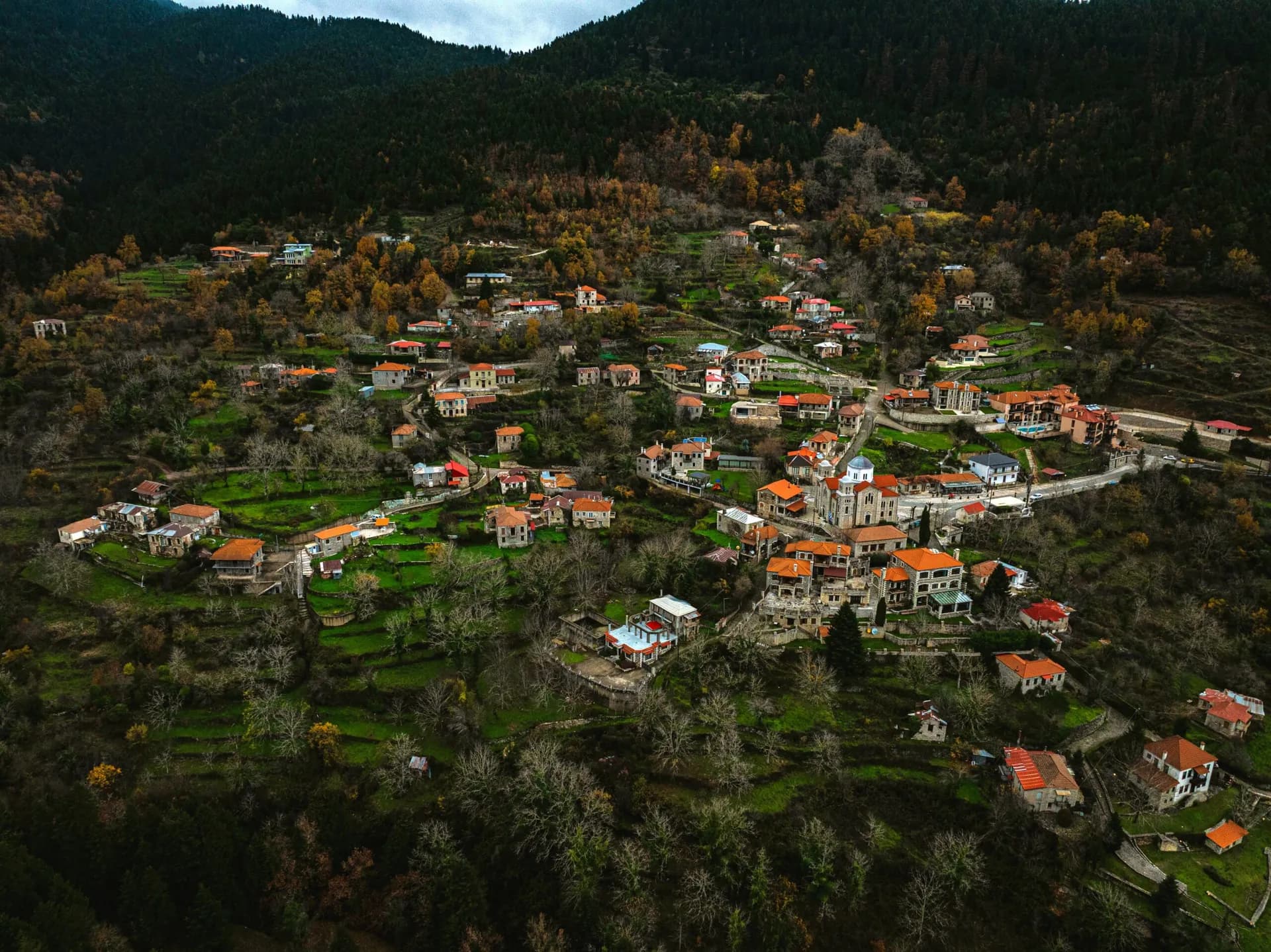
It was early afternoon when our car climbed the final turns toward Kefalovriso, sixty kilometers north of Ioannina. Through the window, the slopes of Nemercika unfurled, covered with dense oak forests, while the village's traditional stone houses, built at 650 meters elevation, began to appear one by one.
This village hides a particular identity. Kefalovriso, formerly known as Metzitie, is Vlach at its heart. Its inhabitants are mainly Vlachs, descendants of herders who for centuries followed nature's cycles. In summer they drove their flocks to Nemercika's mountain meadows, and in October began the long journey on foot to the chimadia, the warm lowlands near the sea.
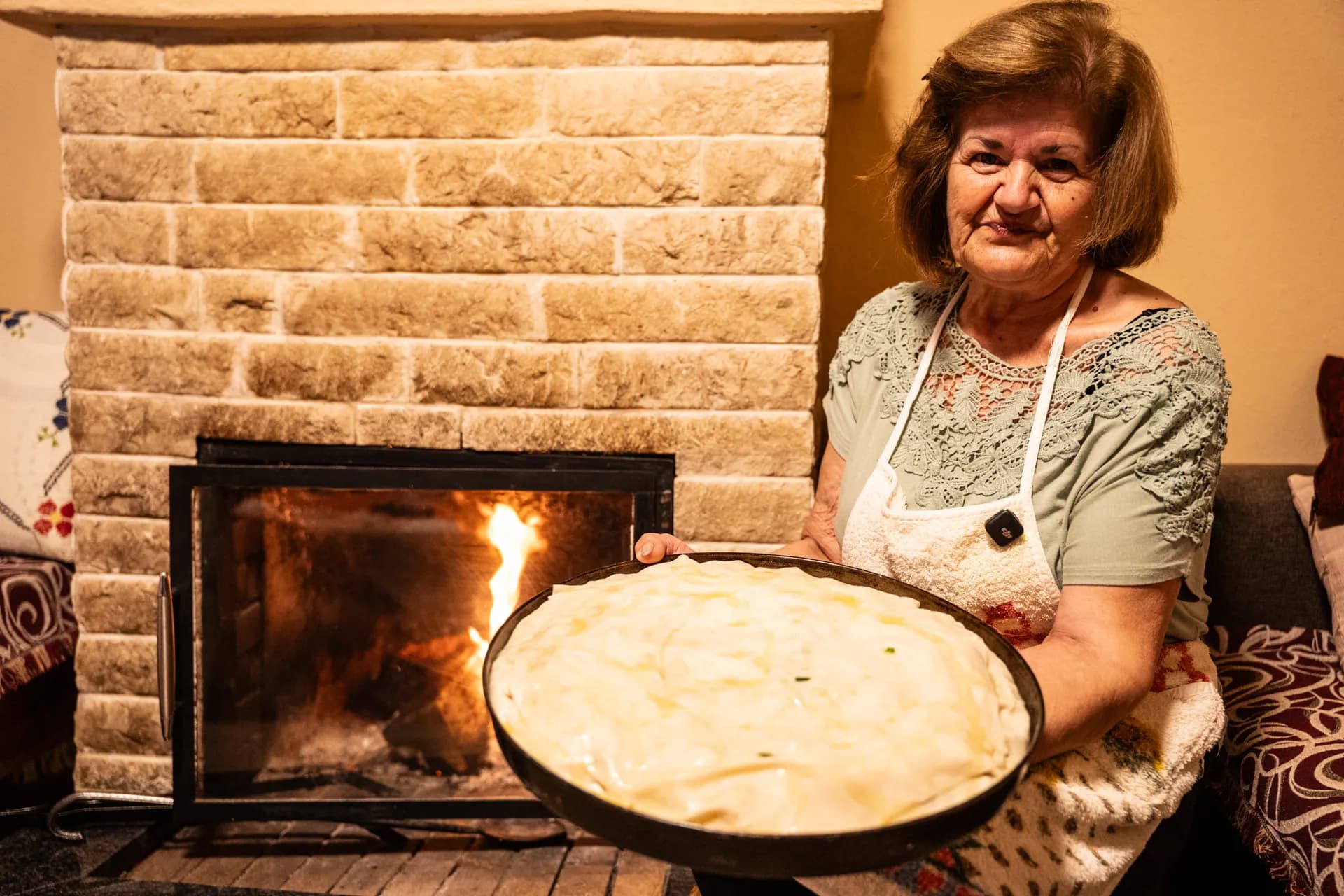
We had spoken by phone the day before. "Come without stress," Mrs. Dina had told me in a warm voice. And when we arrived, she welcomed us with that smile that only people with deep roots know how to give.
Inside, the table was already set. Pasta with meat sauce, fragrant and hot. A lovely tomato salad. And a cheese, feta, that took your breath away with its deliciousness.
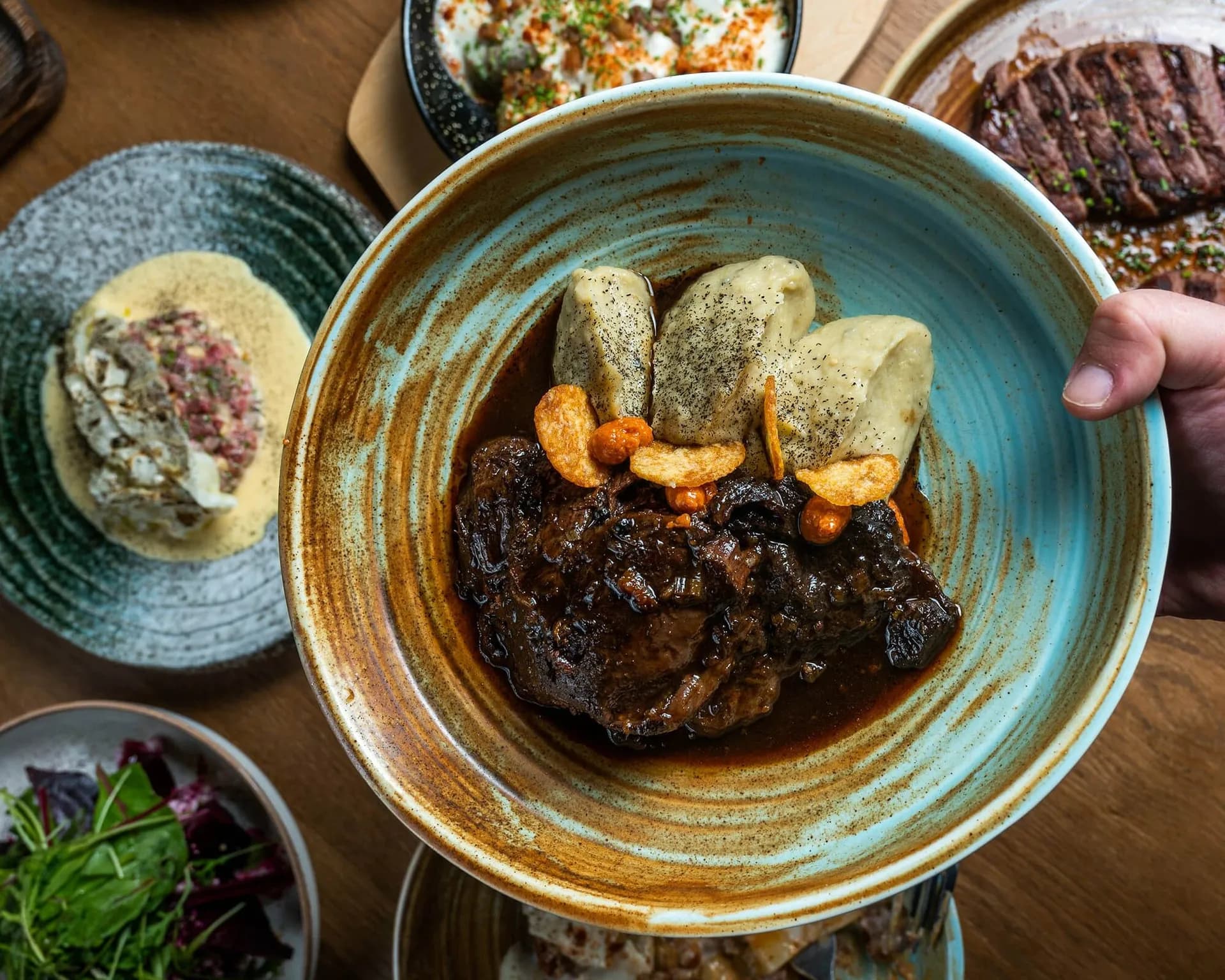
"From the village sheep," she explained simply, as if it were the most natural thing in the world. And of course it was. Here, in the heart of a region with an enormous livestock tradition spanning generations, PDO feta from milk of free-grazing animals is heritage. Pogoni also produces excellent kefalotyri, graviera, mizithra, even the rare "silirotiri," a local gastronomic treasure that rarely reaches the wider market.
The immediate offering of the meal wasn't random. It was the natural expression of a culture based on livestock farming, where there's abundance of meat and exceptional dairy products. Pie and cheese constitute this culture's gastronomic DNA, the portable food of shepherds, the essence of pastoral life. We ate with the calm you only find in mountain villages. The fireplace burned in the corner. We sat beside it. Mrs. Dina made Greek coffee, with rich foam that formed a golden crust.
"Now," she said, rolling up her sleeves.
In that moment, I understood her choice. Mrs. Dina could easily have made a "batsaria," the famous cabbage pie without phyllo, where a batter of corn flour and sour milk covers the greens filling, the pie born from Occupation's absolute deprivation and became a delicacy. She could have made the even faster "kasiopita," a simple batter of flour, eggs, feta, and oil baked over strong fire, sometimes in a special device called "kerkelo."
Instead, she chose the most formal, time-consuming, and laborious pie: cabbage pie with multiple handmade phyllo layers. Her choice was itself a silent act of supreme honor. She spoke with a simplicity and ease that won me over immediately. But this apparent ease, as I would soon understand, was the deep bodily memory of generations, the inscribed knowledge of intangible cultural heritage.
She started with the dough. She put flour on the table, made a well in the middle, and began adding water, a little salt, a little oil. The austere chemistry of Epirote tradition. Only these, nothing more.
Her hands moved with precision but without anxiety. The dough began to take shape, to soften, to become pliable. There were no scales, no timers. Only the sensation of her fingers and decades of experience. She kneaded until the dough acquired that perfect elasticity, capable of transformation.
When the dough was ready, she took the "plastis," the traditional Epirote tool, a thin long wooden rod that craftspeople also call "phyloverga." Its diameter smaller than a finger, its length reaches one meter.
"You must have patience," she told me, without lifting her eyes from her work. "The phyllo requires respect. If you rush it, it tears. If you ignore it, it stays thick and heavy."
She began rolling out the dough with mastery. Her hand moved rhythmically. From center to edges. She wrapped and unwrapped the dough around the rod, and the phyllo became thinner and thinner, larger and larger. I watched fascinated as the opaque dough metamorphosed into an almost transparent sheet, so thin you could see your hand's shadow beneath it.
In another container, she had already prepared the filling. Various wild greens from the mountain, "lahana" as they collectively call them here, mixed with cheese.
This simple description hides an entire botanical world. Knowledge of which greens are edible, when and how they should be collected. This "herb wisdom" is knowledge as old as phyllo rolling. The greens she used were a mix: dock, wild mustards, possibly nettles, chicory, chervil, dill. A "vitamin bomb" containing whatever the mountain offers according to season.
The taste I would try later wasn't something that can be industrially replicated. It was, literally, the taste of Pogoni's wild biodiversity. A flavor profile unique to each preparation, depending on the balance between sweet, bitter, and aromatic greens.
The cheese in the filling, I was almost certain, was the same "delicious" one we had tasted earlier. Mrs. Dina's cabbage pie was the absolute embodiment of place: the mountain's wild flora and the milk of an ancient livestock tradition, embraced by the handmade artistry of phyllo.
She began layering the sheets in the copper pan gleaming in the light. One sheet, a little olive oil, another sheet. Then the filling, spread evenly. And again sheets on top. On top, a few more drops of oil, almost ritualistically.
"The oil gives the flavor and makes it crispy," she explained.
Oiling each sheet separately is the secret to the texture that makes Epirote pie stand out. The oil acts as an insulating layer, preventing the sheets from sticking. During baking, the trapped steam separates them, while the oil itself essentially lightly fries each individual sheet. This very process creates that coveted, crispy result.
In many culinary traditions, a pie's casing is only a carrier for the filling. In Epirus, this is unthinkable. The phyllo is judged autonomously for its flavor and texture. The tradition in Pogoni, as craftspeople from the region attest, places absolute emphasis on the phyllo being pure, quality, crispy.
She put it in to bake. Just over an hour had passed when the pie was ready. The kitchen had filled with a smell I can't describe in words. A smell combining the crunch of baked phyllo with the earthy aromatics of greens and the rich scent of local oil.
With scissors, she cut it into pieces. The pie was still steaming, but I couldn't resist. The first bite was revelation. The phyllo crispy and flavorful, almost caramelized from the oil. The filling hot and fragrant, with the taste of greens exploding in the mouth. The cheese melting and binding all the flavors together. The phyllo had its own autonomous gustatory entity, a co-protagonist equally important as the filling it embraced.
It was the epitome of pie. Simple, pure, absolutely connected to this place. A taste that can't be found elsewhere, because it is Pogoni's very essence.
We said goodbye to Mrs. Dina when night had already fallen. The village had sunk into darkness and house lights were coming on one by one. "Be careful on the road," she told us. "There are many wild boars."
This seemingly insignificant warning hides the greatest truth about contemporary life in the region. Pogoni, with its dense oak forests and rich fauna, always hosted wild life. But in recent years, the wild boar population has shown explosive growth. They destroy thousands of acres of cultivated land, mainly corn, causing incalculable damage to farmers and herders.
The pie experience, an act of harmony between human and nature, clashed with harsh reality. The pie that had just been prepared was a product of this land. And this land is in crisis.
She gave us some pieces of pie to take with us. The Epirote pie is an act of care that extends through time. The hostess, giving pie for the road, ensured that her hospitality would accompany us the next day too.
The next morning at the hotel, we had the best breakfast. Pieces of Mrs. Dina's pie, cold now but equally wonderful. The pie, even cold, retained that crispiness, that complexity of flavors.
In Kefalovriso, as in many Pogoni villages, time flows differently. Traditions aren't museum pieces. They're living practices, bodily memory passing from generation to generation.
Mrs. Dina doesn't make pies to impress. She does it because that's how she learned, because that's how her family eats, because this is her way of remaining connected to her roots. The apparent simplicity and ease with which she moves is the deep bodily memory of generations.
As we moved away from the village, looking back at Nemercika's slopes, I understood that I hadn't simply tasted an exceptional pie. I had been initiated into a ritual. The transformation of nothing into everything, the preservation of art through practice, the expression of hospitality as supreme honor.
In a world running faster and faster, Mrs. Dina's home remains a refuge of authenticity. A place where food is still art, hospitality is still sacred business, and tradition is honored with every phyllo sheet rolled out, with every pie baked.
Mrs. Dina's cabbage pie was, ultimately, the epitome of Pogoni itself: proud heritage, intangible art, wild taste, and a harsh reality that resists. As long as there are hands like Mrs. Dina's, Epirus's soul will continue to live, one phyllo sheet at a time.
Frequently Asked Questions
What makes Greek food unique?
Greek cuisine is built on simplicity and quality ingredients. What makes it distinctive is regional variety — every island and mountain village has its own flavors, often unchanged for centuries.