His cheeses carry within them the island's history, the scent of its herbs, the salty air of the Ionian Discover Greece with a local expert.
His cheeses carry within them the island's history, the scent of its herbs, the salty air of the Ionian.
In the afternoon, the sun bathes the waters of the harbor in Vathy, Ithaca, with golden light, and the sea's saltiness mingles with the aromas of herbs growing on the island.
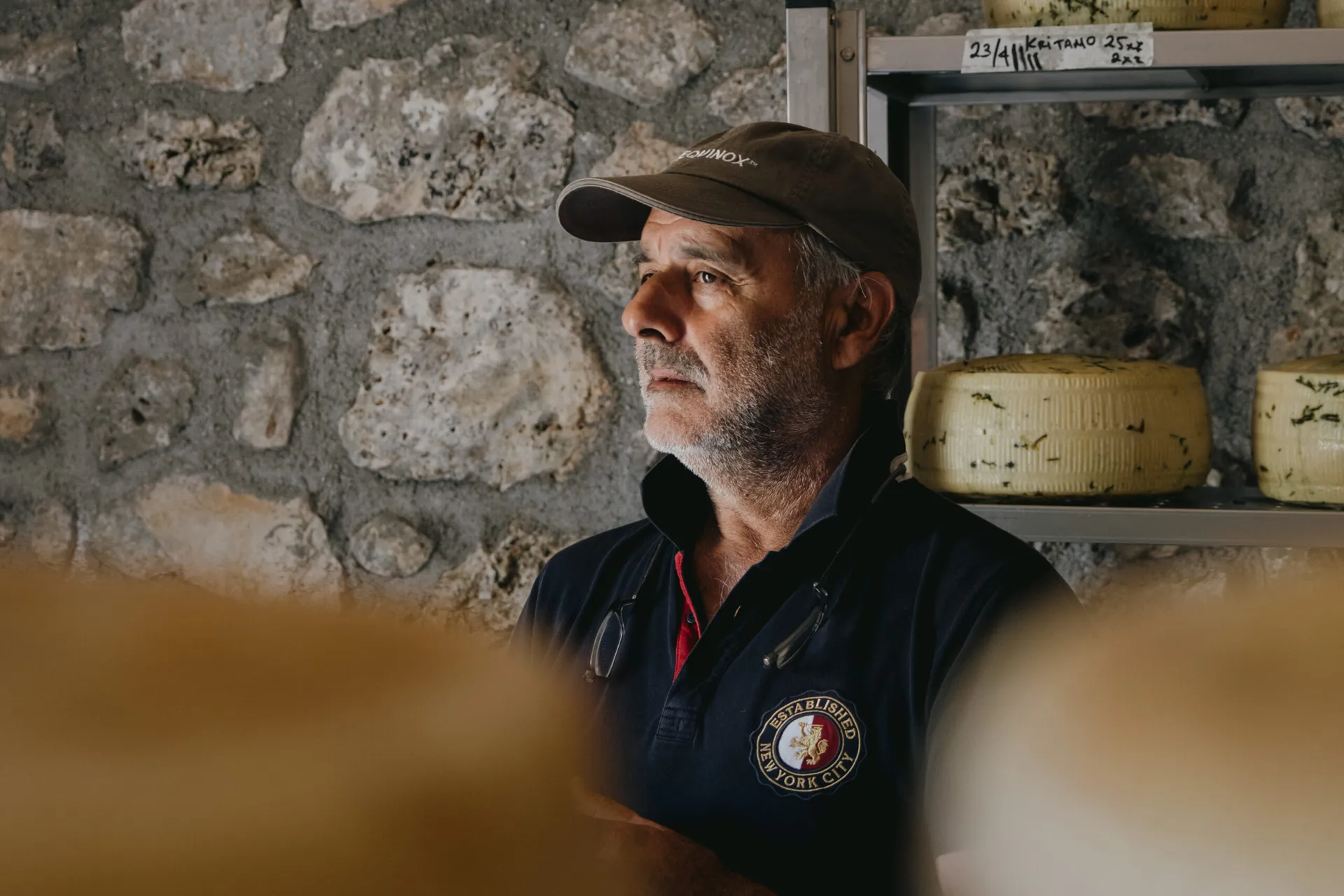
There, Chrysanthos Karavias awaits us: until yesterday, just a name I'd heard spoken of warmly by winemaker Sklavos in Kefalonia. "Go see what Chrysanthos is doing in Ithaca," he told me. "Something unique." And now, as we follow him by car to the estate housing his cheese dairy, I begin to understand what he meant.
Chrysanthos Karavias, beyond being a cheesemaker, is someone who heard the call of his roots and followed it. Born in 1959 in Santorini, where his family had emigrated from Ithaca in the early 20th century, he lived for years as a successful entrepreneur in tourism. Until 2000, when he first set foot on his ancestors' land.
"Arriving at the island's harbor by ferry, I immediately felt the energy and magic of this land of my ancestors," he confides as he gives us a tour of the cheese dairy he transported here in a container and installed with all safety protocols. "I decided to return and live in Ithaca, to return to my roots."
The cheese dairy operates with all modern safety standards, but its "soul" lies elsewhere. He leads us to the cave where he ages his cheeses, and there, among dozens of wheels quietly ripening, Chrysanthos tells us about his vision. "Living here daily, I realized I was surrounded by pure raw materials," he explains, his eyes shining. "From the milk of local animals living freely in nature to the unique herbs growing everywhere, as well as this place's special natural environment." His initial thought was simple: to buy the island's milk and make local cheeses. An effort that not only succeeded but today he purchases all the milk produced on the island.
"Katseno" is at the core of Chrysanthos's cheesemaking philosophy. It's an ancient sheep breed that lives only in Ithaca. "It's born rust-colored and as it grows, its fur whitens, while the rust color remains on its face and legs," he says. "It has lived freely in nature since Odysseus's time." Katseno milk gives his cheeses a unique character. The first cheese he made took its name from this special animal: a white cheese enriched with herbs exclusively from the area. "I took the idea from the Aegean round cheese, the small cheese we make in the Aegean," he explains. "After many trials, some herbs worked and some didn't."
The search for a yellow, hard, and spicy cheese led Chrysanthos to create "Lazareto," a graviera that took its name from the lazarettos that existed in every Ionian port. "I wanted to make something different and combine it with local herbs," he notes. The journey wasn't easy. He collected more than 100 species of Ithacan herbs, processed them in different ways, and tested them. After a long period of experimentation, six versions were born: plain, with savory, with triboli, with rock samphire, with ginger, and with seaweed coating.
Four years later, his dream of finding goat's milk came true. "In Ithaca, very few goats are milked," he explains. "And they add their milk to sheep's milk to give it scent, like salt and pepper." "Gidaki" (or "Idaki" as Nikos from the canteen at the homonymous beach christened it) was created with the help of beloved Ithaca locals. Even its label was designed by the local school's art teacher on a café napkin during a celebration.
Perhaps the most characteristic of Chrysanthos's cheeses was born almost by accident. "We forgot about a white cheese for a few days and remembered it one afternoon," he recounts. "The cheese had started to ripen and turn yellow. Its taste and aromas thrilled us."
He decided to produce it but wanted it to happen naturally. "As in ancient times, as Homer describes in his myths, that is, inside natural caves." The name "Tsemberis" is a tribute to his family; it was the Karavias family's nickname.
As we wander among the cheeses ripening in the cave, Chrysanthos shares his philosophy with us. "I create cheeses from local milk. Starting with myth and tradition, my cheeses are infused with sea air and the passion that makes them special."
He's a friendly person who enjoys sharing his knowledge and experience. In every word, you can discern his love for the place, tradition, and the need to experiment, to create something new from the old.
Chrysanthos's cheeses, which circulate under the brand "Ithaca's Poem," are the material expression of a vision connecting past with present. Each cheese wheel carries within it an island's history, the scent of its herbs, the salty air of the Ionian.
Leaving the estate, as the sun sets behind Ithaca's mountains, I realize that Chrysanthos Karavias resembles a "modern Odysseus" who found his way home and decided to share it with the world.
Common Questions
Is food on the famous islands overpriced?
On the cliffs and waterfronts, yes — significantly. But one street back from the view and prices drop by 40%. My rule: if the restaurant has a sunset photo on the menu, you're paying for the photo. The best meals I've had on the islands were in unmarked spots where the only language on the menu was Greek.
What's actually worth eating versus tourist food?
Fresh fish, local cheese, whatever the kitchen made that morning. Avoid anything on a laminated card described as 'traditional Greek food.' Ask for the daily special. Ask what arrived at the market this morning. That conversation alone tells you whether you're in the right place.