The Koresteia villages, built from bricks made with the region's red soil By food journalist Dimitris Stathopoulos.
The Koresteia villages, built from bricks made with the region's red soil.
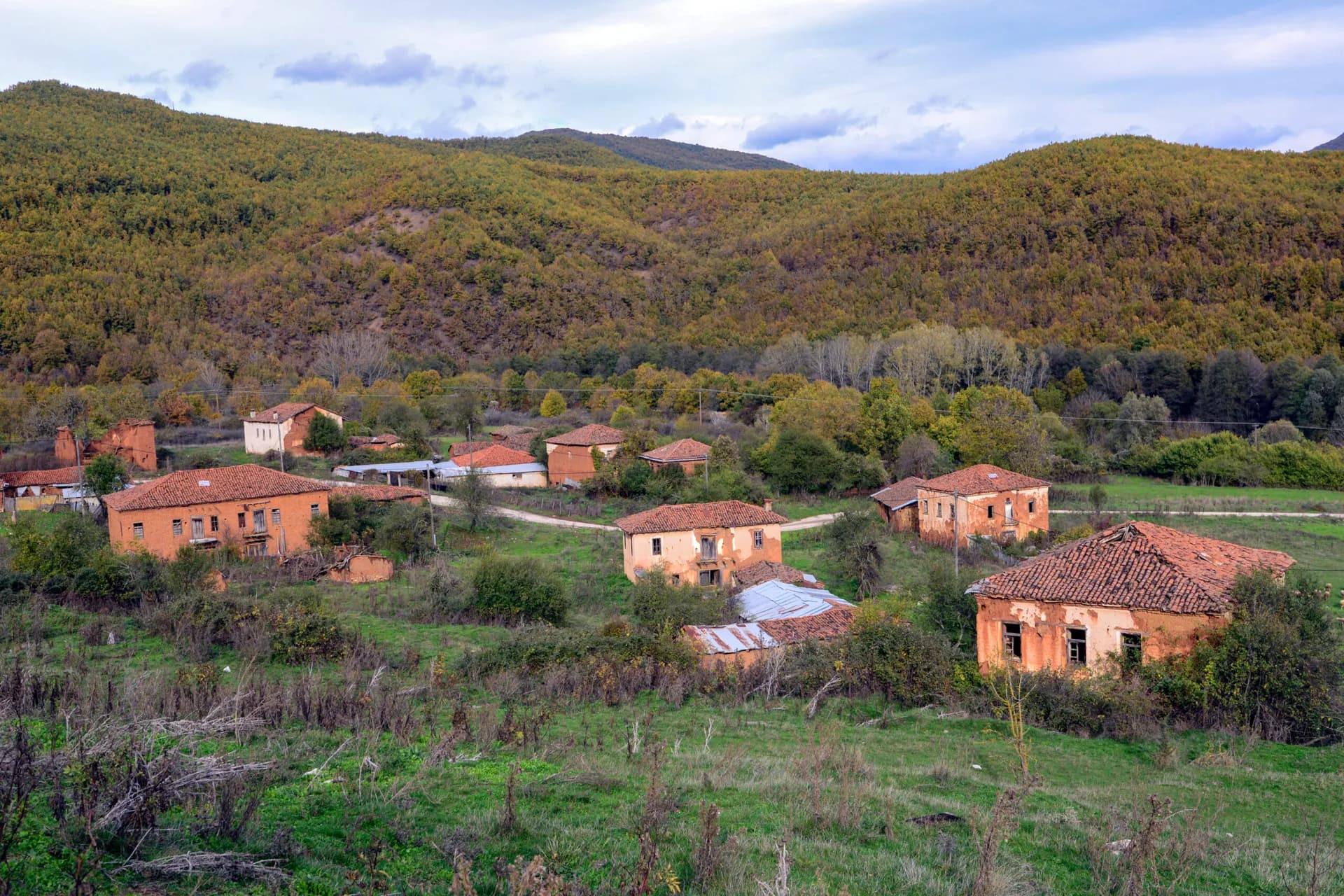
Days ago, while we were still planning our trip to the Kastoria region, I had been told about the abandoned "red villages." Just hearing about them, I added them straight to the list. These are the Koresteia villages, built from bricks made with the region's red soil. Gavros, Mavrokampos, Chalara, Kraniona, and some others, in the quiet valley of Ladopotamos. They're all deserted and left to their fate. At the same time, however, they constitute unique examples of traditional architecture with clear references to the Civil War. It's as if you're taking a walk in front of a film set while simultaneously journeying through the place's recent history.
Let's look at things from the beginning. These villages were built in the first half of the 19th century, and for their construction they used bricks with a mixture of mud from red soil and straw, which they made on site and left in the sun to bake. Contemporary architects characterize this construction method as early bioclimatic, since, among other things, they face south, while on their northern section they have no opening, thus ensuring coolness inside in summer and warmth in winter.
Everything around (the size of the houses and the remaining objects) testifies that once these brick villages prospered and pulsed with life. The inhabitants were farmers, livestock farmers, and craftsmen who dealt with fur processing during the era when the fur trade flourished in Kastoria. Notable are the mansions with elegant decoration, surrounded by beech forests and exuding a historical atmosphere.
In Upper Kraniona, one can see the church of Agia Paraskevi with the relief plaque showing the village's layout and family names. In Chalara, besides the brick-built houses, there's a watermill from 1900 and the brick-built church of Panagia from 1717, while in Mavrokampos impressive mansions with warehouses and large rooms with fireplaces are preserved.
Starting from Kastoria, we needed less than 30 minutes to reach the Gavros settlement. The first image is breathtaking, as turning left from the main road, you see the slope with the imposing red houses. We leave the car and walk. We steal glances into the interior of some houses, some of which have been converted into haylofts or even stables. A little below, a shepherd takes the animals to pasture with the sheepdogs doing their work with severity.
This region has witnessed and been the field of harsh battles. Here, during the period of the Macedonian Struggles in 1904, in the village of Melas, Pavlos Melas was killed by the Turkish army. Then, in the 1940s, the villages were deserted and their inhabitants expelled. Many were those who emigrated, mainly to America and Canada, while some others to the Balkans.
Frequently Asked Questions
What makes Greek food unique?
Greek cuisine is built on simplicity and quality ingredients. What makes it distinctive is regional variety — every island and mountain village has its own flavors, often unchanged for centuries.