The road from Ioannina toward the Greek-Albanian border is an experience in itself By food journalist Dimitris Stathopoulos.
The road from Ioannina toward the Greek-Albanian border is an experience in itself. The Ioannina-Kakavia national road cuts through a region that seems untouched by time. The autumn landscape is truly spectacular: the centuries-old oak trees covering vast areas take on a deep, metallic copper hue. Among them, maple trees explode in chromatic bursts.
This visible expression of the region's deep ecological health, which counts more than 1,700 plant species, is only the beginning. Passing through Kalpaki, with its imposing War Museum and giant soldier statue recalling the 1940 epic, the route acquires historical weight. Shortly before the final ascent, a stop at Lake Zaravina is mandatory. Fourteen kilometers before the border, this "microscopic blue gem," as visitors describe it, emerges from the oak forest. A protected biotope with a conical bottom and depth of 31 meters, it offers a moment of absolute tranquility.
Arrival at the Edge
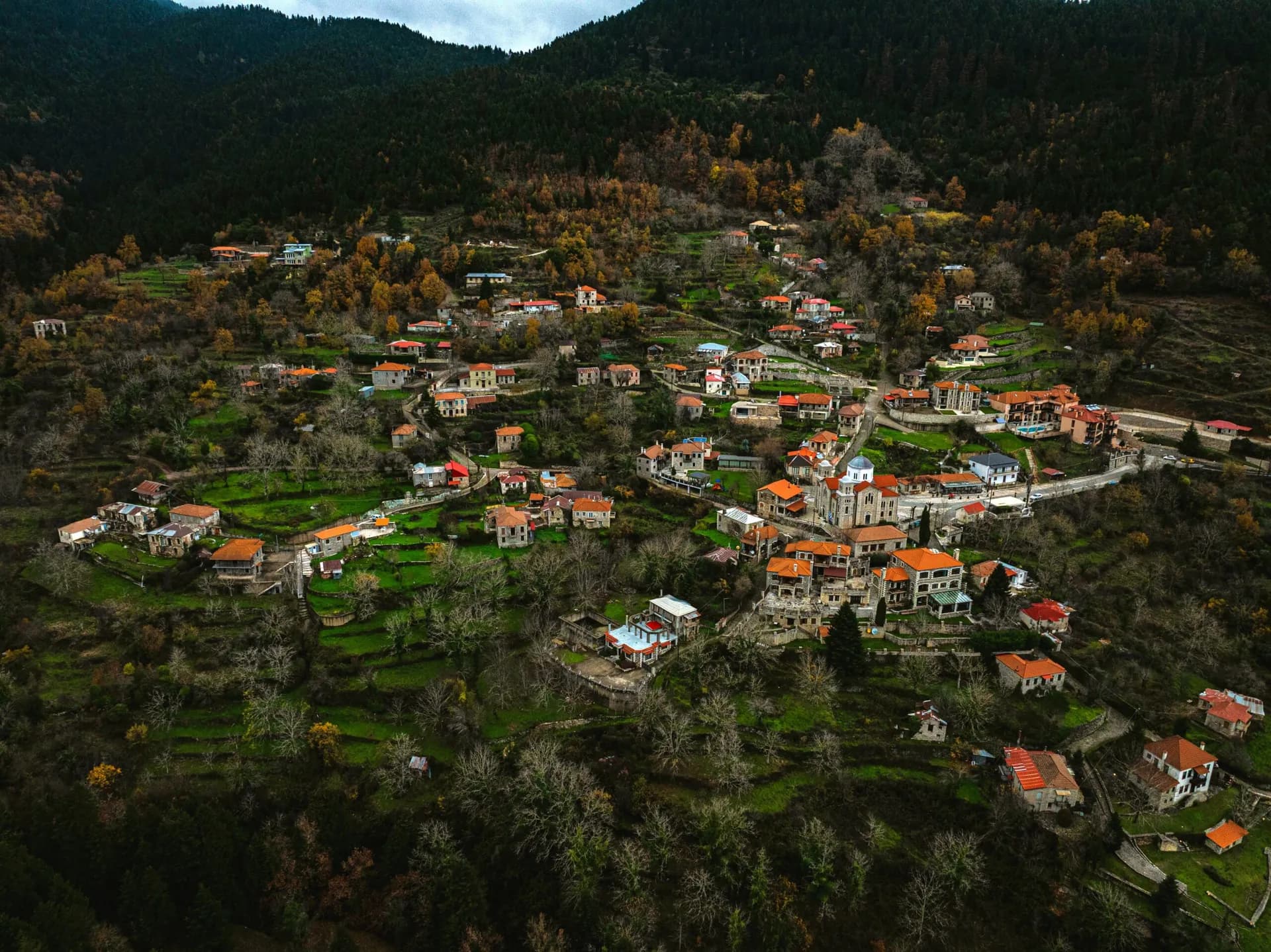
Arriving at Drimades surprises you. The village appears built at an elevation of 1,040 meters, on the slopes of Mount Dousko, mere meters from the Greek-Albanian border. It's one of the most mountainous settlements in Ioannina prefecture. The first sensation that overcomes you is silence. The buildings testify to a past full of life.
Classic Epirote architecture is everywhere: stone schools, impressive girls' and boys' schools, elaborate stone fountains in the square. These buildings are witnesses to a past where the community invested in its future. No one builds an imposing stone school if they don't have children and the expectation of more. In the square, the Church of Saint Nicholas dominates. Built in 1733, a three-hundred-year-old church recently restored, it stands today as a witness to the village's life and decline.
The Numbers Tell a Story
In 2001, Drimades had 127 residents. In the 2021 census, residents had fallen to 27. But the official statistics become even harsher when you face reality. We searched in vain to find someone among the few residents, only 4 permanent inhabitants. The architectural investment of a bygone century (schools, churches, fountains) now stands almost empty, a shell guarded by the four remaining frontier guards.
Leaving the square and heading toward the village edge, past and present collide deafeningly. Very close to the Greek-Albanian border stands a chapel, also dedicated to Saint Nicholas. Standing here, you literally tread upon History. At dawn on October 28, 1940, Italian invaders simultaneously attacked the Greek outposts. Drimades was one of them. Along with Kakavia, Kastaniani, and Argyrochori, the Drimades outpost was on the front line that received the attack. This quiet, mountainous landscape was ground zero, the war's beginning.
The 19 Million Euro Ghost
Taking a few steps from the heroic past of 1940, you stumble upon the contemporary paradox: the "Drimades Customs." The image is surreal. Carcasses of modern facilities, buildings constructed to house passport control services, now rot unused. This is one of the most glaring examples of state and European indifference.
The story of this paradox is infuriating. For the construction of the border station and road access, 15 million euros were spent from the Interreg cross-border program and the Ioannina Prefecture, plus another 4 million euros from the Albanian side. A project totaling 19 million euros.
The project was necessary. It was designed to facilitate the "dense daily back-and-forth" of residents, especially from Greek-speaking villages on the other side of the border who maintain strong ties with Greek Pogoni. The result? Official inaugurations were held, but the station "never operated." In 2009, prefabs, networks, and infrastructure were installed, but a year later it was announced that the Schengen Treaty didn't allow its operation. Finally, in 2012, it was officially abolished by Presidential Decree.
The human consequences are unbearable. Elderly compatriots are forced to make a 2 to 3-hour loop via Kakavia to reach their homes, a distance that via Drimades would cover in a quarter of the time.
Nature's Redemption
Having reached the nadir of abandonment (the ruined customs, the four residents), you seek signs of life. And you find them, not in failed state investments, but in nature and tradition. From Drimades, four major routes begin, with the most significant being the 6-hour ascent leading to the Nemertsikas summit at 2,208 meters elevation.
Following an easier mountain route, you reach the chapel of Holy Trinity, at the foothills of Nemertsika. Walking in the mountains, away from the customs "carcasses," works as an act of catharsis.
Stavroscadi: A Green Amphitheater
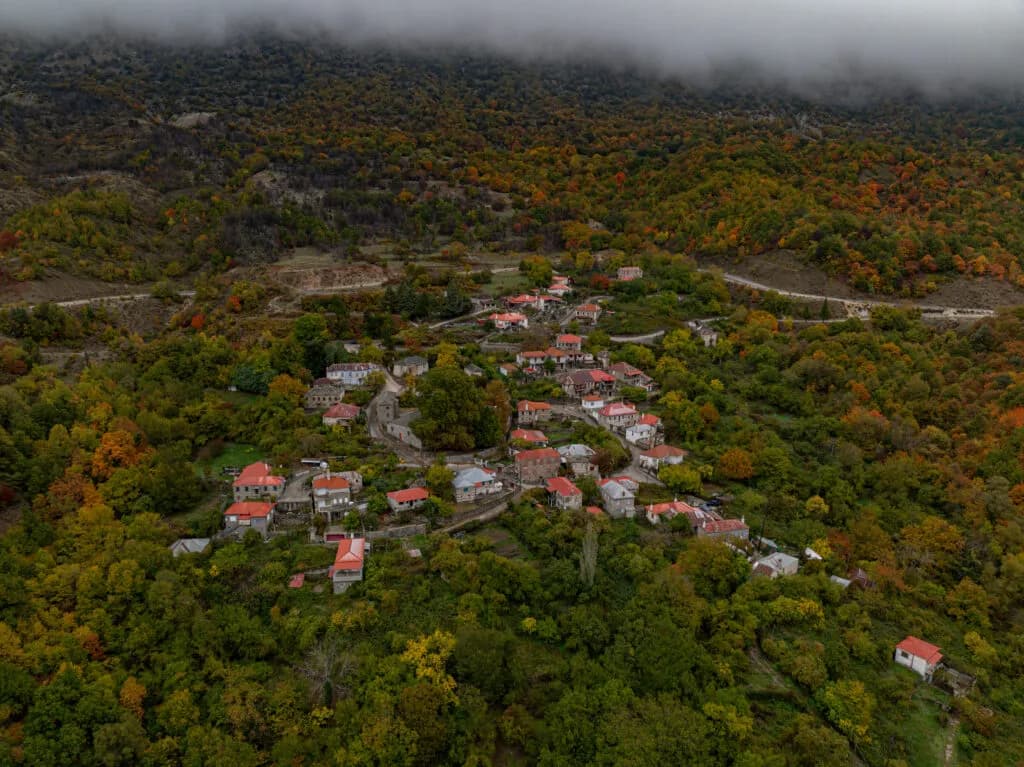
Returning, we entered Stavroscadi, a traditional village at 918 meters elevation hidden beneath the region's towering mountains. Low, stone-built houses with red tiles spread across a green "amphitheater," while old mansions with carved stone entrances and large enclosures testify to another era.
In the square, towering trees shade the stone cobblestones, and from everywhere the gaze is lost in endless expanses of green. Here, every August on the feast of Saint Paraskevi, the village comes alive with a daytime festival, local dishes, and traditional music. And when winter comes, the chimneys of the few inhabited houses emit smoke smelling of wood and freshly cooked food.
The sun sets behind Nemertsika as the return journey begins. The amazingly beautiful landscapes are still there, charged with meaning. These slopes are the memory of 1940. The modern road is the irony of a lost dream. Pogoni, and especially the frontier settlement of Drimades, is a place for travelers who want to meet authentic people and places not altered by tourism. It's a place that speaks, provided you can endure its silence.
Frequently Asked Questions
What makes Greek food unique?
Greek cuisine is built on simplicity and quality ingredients. What makes it distinctive is regional variety — every island and mountain village has its own flavors, often unchanged for centuries.