The Panagia Stomiou Monastery appears suddenly, perched at 2,100 feet, clinging to an outcrop on the slopes of Mount Tymfi By food journalist Dimitris Stat
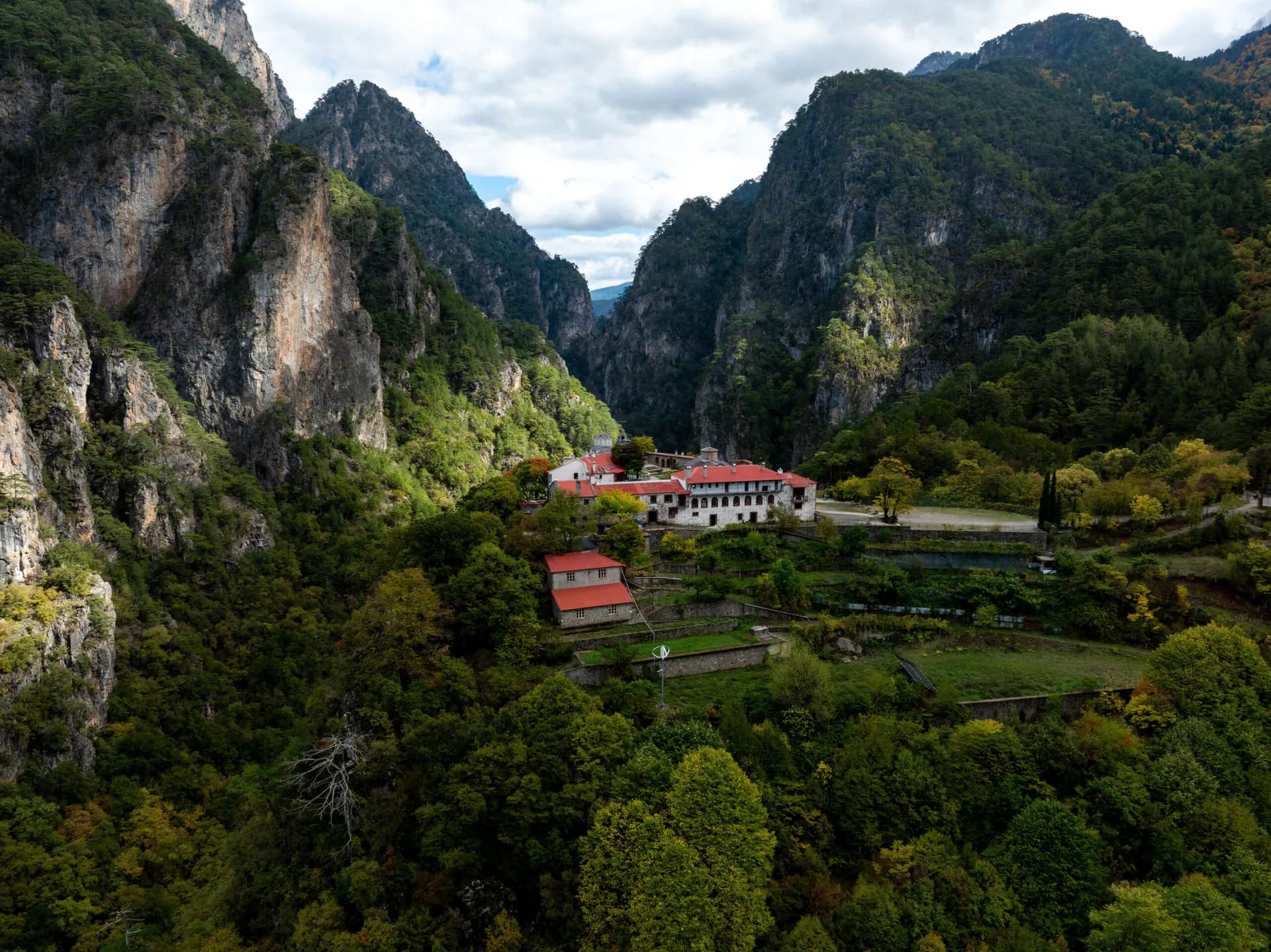
The Panagia Stomiou Monastery appears suddenly, perched at 2,100 feet, clinging to an outcrop on the slopes of Mount Tymfi.
The bridge of Konitsa stands over the Aoos River like a stone challenge to gravity. A 120-foot span, 65 feet high, with a small bell beneath its arch (a historical relic that once warned travelers when the gorge winds turned dangerous). In 1870, master builder Ziogas Frontzos from Pyrsogianni, with a crew of fifty men, constructed this work funded by the residents and primarily by Ioannis Loulis from Ioannina. Here, the trail to Stomiou Monastery begins: roughly an hour and a half walk that's equal parts geographic mission and pilgrimage.
The first few miles follow the right bank of the Aoos. The trail, cobblestone at the start, alternates with dirt road and unfolds through vegetation that shifts with every turn. Hornbeams, hop-hornbeams, oaks: the mountain flora forms a dense canopy over the path. Somewhere mid-route, the Gravos stream, which springs from beneath Drakolimni in the Tymfi highlands, crosses the trail with small stepped waterfalls. The sound of water accompanies every step.
After roughly forty minutes parallel to the river, the trail turns and begins to climb. The ascent cuts through forest, gradually pulling the hiker away from the Aoos. Here, the Epirus Trail meets the older path, and the choice is obvious. The old trail offers a more immediate sense of the gorge's wild architecture.
The Panagia Stomiou Monastery appears suddenly, suspended at 2,100 feet, on an outcrop of Tymfi's slopes. Its location is geological poetry, between Tymfi rising to 8,190 feet and Trapezitsa at 6,640 feet, overlooking the narrowest section of Aoos Gorge, where the river wedges between the rocks and justifies the name "Stomio" (mouth).
The monastery's history is one of migrations and survival. Founded in 1442 on the opposite slopes of Trapezitsa, where today only the name "Paliomonastero" (Old Monastery) survives. In 1774, Abbot Konstantinos decided to relocate it to its current position: more accessible but equally impressive. In 1943, the Germans burned it almost completely. Only the church survived.
Today, the monastery is an active men's monastery. Eleven cells, a cruciform katholikon with a dome, an iconostasis with Byzantine icons transferred from the Old Monastery. Relics of saints, carefully preserved, connect the present with centuries of faith. On the back side of the monastery, a small cell holds a special memory. Here, Saint Paisios lived as an ascetic for four years, leaving his own mark on the place. Every September 8th, the trail from Konitsa fills with pilgrims. Hundreds of people from the town and surrounding area climb for the feast day, transforming the monastic quiet into celebration.
Aoos Gorge isn't just a natural landscape. It's part of the Vikos-Aoos National Geopark, recognized by UNESCO as a monument of global natural heritage. The steep slopes, dense vegetation, geological formations: all compose an ecosystem of rare ecological value.
From the summit, beside the monastery, the view of the gorge reveals the scale of the landscape. The Aoos runs deep below, Tymfi's slopes rise indifferent, and the monastery stands in the middle: human presence in a world that doesn't need humans to exist, but offers them refuge when they seek it.
The descent to Konitsa is faster than the ascent. The trail, well-marked and without dangers, returns to Ziogas Frontzou's bridge. There, all that remains is to watch the Aoos run beneath the arch and realize that some journeys aren't measured in miles. They're measured by what they leave behind.
Frequently Asked Questions
What makes Greek food unique?
Greek cuisine is built on simplicity and quality ingredients. What makes it distinctive is regional variety — every island and mountain village has its own flavors, often unchanged for centuries.